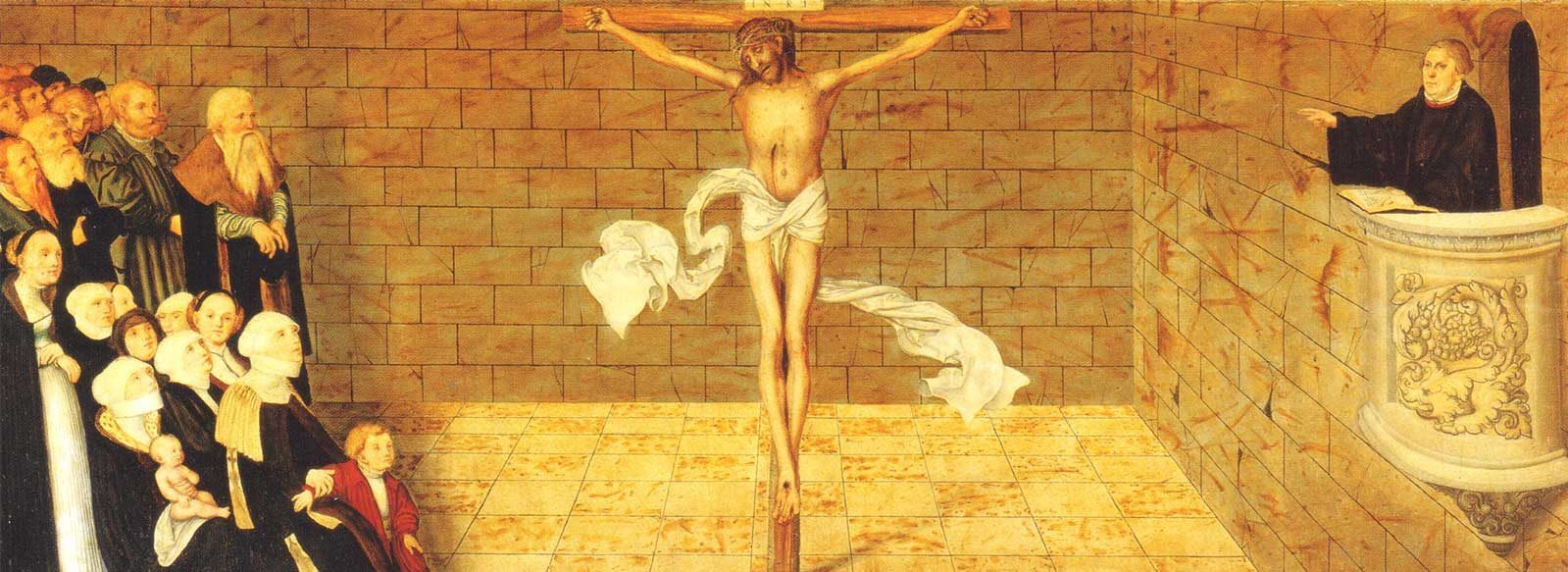
This gets me every time. From a French Reformed Baptismal Liturgy:
“For you, little child,
Jesus Christ has come, he has fought, he has suffered.
For you he entered the shadow of Gethsemane and the
horror of Calvary.
For you he uttered the cry, ‘It is finished!’
For you he rose from the dead
and ascended into heaven
and there he intercedes —
for you, little child, even though you do not know it.
But in this way the word of the Gospel becomes true.”
“We love him, because he first loved us.”
This gets me every time. From a French Reformed Baptismal Liturgy:
“For you, little child,
Jesus Christ has come, he has fought, he has suffered.
For you he entered the shadow of Gethsemane and the
horror of Calvary.
For you he uttered the cry, ‘It is finished!’
For you he rose from the dead
and ascended into heaven
and there he intercedes —
for you, little child, even though you do not know it.
But in this way the word of the Gospel becomes true.”
“We love him, because he first loved us.”
I've been thinking about the three doctrines of 321 and how they interact with the four events of more traditional gospel outlines. Previously I've discussed Creation and Fall. Now we'll look at Christ's work of redemption.
How does 3 shape our understanding of Christ's redemption
I don't think I know any gospel outlines that begin with the Trinity. (If you know of any, please tell me). But if a presentation does not have the Son of God "in the beginning" it's going to be awkward to crow-bar him in later.
How will Jesus be introduced as anything greater than a Prophet in a scheme that does not begin with His divine glory. Instead, the introduction of Jesus into gospel explanations can only befuddle the non-Christian who is prone to ask "Who is this guy? What's he got to do with this creation and fall business you've been speaking of?"
In so many schemes Jesus comes late to fix a problem he's not been involved with. This has massive implications for the presentation of his Person - does he really come across as fully God? And it hugely affects the presentation of his work - he looks for all the world like an innocent third party interposed into the God - man dilemma.
John Stott saw the desperate need for a trinitarian framing of the cross when he wrote:
At the root of every caricature of the cross there lies a distorted Christology… In particular, it is essential to affirm that the love, the holiness and the will of the Father are identical to the love, the holiness and the will of the Son. God was in Christ reconciling the world to himself. (The Cross of Christ)
The doctrine of penal substitution - which I both affirm and love - has been attacked in recent years. But the version of it that has aroused such scorn has often been the non-trinitarian caricature which Stott wrote against. If we're going to uphold the glory of the cross we must put it in its proper trinitarian context.
How does 2 shape our understanding of Christ's work of redemption?
Why did Christ have to become a man? Why couldn't the Son have incarnated as a literal Lamb? Or why couldn't God have "zapped" the wooden cross, rather than his Son? If redemption is simply about the just justification of sinners in the punishment of the Son - why does Jesus become our Brother? Couldn't God's wrath have been poured out on a non-incarnate Son?
No, no, no! The Son takes our flesh because he's entering into our plight and transforming it from the inside. As many church fathers have put it: He became what we are, so that we might become what he is. Redemption is not simply the balancing of the punishment books. It's about our Maker summing up his creation in himself - taking responsibility for it. His penal substitutionary death is absolutely vital. On the cross he is "carrying the can" for his handiwork. But that act is comprehended within a vast work of creation and redemption - moving humanity (and in humanity, the cosmos) through death and curse to life and glory.
Of course the Son had to become Man. Man rules the world. Adam - the pattern of the Coming One (Rom 5:14) - stood over creation, ruling and blessing it. Through the fall, he failed and cursed it. Christ comes to wrest humanity (and in humanity, the world) back to God. In his resurrection, he takes us through death and into an immortal physical glory. This is the cosmic dimension to salvation which will always be missed when we construe the gospel as, simply, the answer to 'my sin'. 'Adam and Christ' vitally connects Jesus' work to this flesh and this world. Without it, as Paul argues in 1 Corinthians 15, we have no gospel.
How does 1 shape our understanding of Christ's work of redemption?
So 3 assures me that Jesus is God. 2 assures me that Jesus is Man. But you might well think - so what? I'm still left on the outside of all this. And at this point two questions become vital to ask and answer:
1) How do Ibenefit from the Person and work of Jesus?
2) What do I do once I have appropriated Christ's salvation?
In answer to the first question, many gospel presentations put the task firmly into the sinner's hands. Jesus has "cleared the path" through his death and resurrection, now the sinner must "take the step of faith" and come to God. The appropriation of Christ's benefits happens through "the sinner's prayer" in which we ask for - and God zaps into our account - forgiveness, righteousness, the Spirit and eternal life. Jesus does not really mediate these benefits, he only pays for them. And this leads to a problem in answering that second question: What now?
Now that I've stepped across Jesus - "the bridge" - what is the Christian life? I've got forgiveness and eternal life, so how will the evangelist tell me to continue? Probably they'll tell me to go to church, read my bible, pray, try hard not to sin and hold on tight till heaven. To which I'm liable to say "Why??! What connection does any of that have to what you've described in your sales pitch?!"
But no. We benefit from the Person and work of Christ because he is given to us in marriage union. All that is mine is his - he takes my sin and shame and covers over it. All that is his is mine - he gives me his status, his inheritance, his family connections. Best of all he gives me himself. And this is the Christian life: belonging to Jesus and he to me.
So of course the Christian now belongs to his body, of course they listen to him (in the bible) and speak to him (in prayer). It's all organically related to Jesus himself. That's a salvation - and a salvation message - that makes sense.
But without Trinity, Adam and Christ and union with Christ, the very heart of the gospel - Christ and his work - will be radically misunderstood.
I've been thinking about the three doctrines of 321 and how they interact with the four events of more traditional gospel outlines. Previously I've discussed Creation and Fall. Now we'll look at Christ's work of redemption.
How does 3 shape our understanding of Christ's redemption
I don't think I know any gospel outlines that begin with the Trinity. (If you know of any, please tell me). But if a presentation does not have the Son of God "in the beginning" it's going to be awkward to crow-bar him in later.
How will Jesus be introduced as anything greater than a Prophet in a scheme that does not begin with His divine glory. Instead, the introduction of Jesus into gospel explanations can only befuddle the non-Christian who is prone to ask "Who is this guy? What's he got to do with this creation and fall business you've been speaking of?"
In so many schemes Jesus comes late to fix a problem he's not been involved with. This has massive implications for the presentation of his Person - does he really come across as fully God? And it hugely affects the presentation of his work - he looks for all the world like an innocent third party interposed into the God - man dilemma.
John Stott saw the desperate need for a trinitarian framing of the cross when he wrote:
At the root of every caricature of the cross there lies a distorted Christology… In particular, it is essential to affirm that the love, the holiness and the will of the Father are identical to the love, the holiness and the will of the Son. God was in Christ reconciling the world to himself. (The Cross of Christ)
The doctrine of penal substitution - which I both affirm and love - has been attacked in recent years. But the version of it that has aroused such scorn has often been the non-trinitarian caricature which Stott wrote against. If we're going to uphold the glory of the cross we must put it in its proper trinitarian context.
How does 2 shape our understanding of Christ's work of redemption?
Why did Christ have to become a man? Why couldn't the Son have incarnated as a literal Lamb? Or why couldn't God have "zapped" the wooden cross, rather than his Son? If redemption is simply about the just justification of sinners in the punishment of the Son - why does Jesus become our Brother? Couldn't God's wrath have been poured out on a non-incarnate Son?
No, no, no! The Son takes our flesh because he's entering into our plight and transforming it from the inside. As many church fathers have put it: He became what we are, so that we might become what he is. Redemption is not simply the balancing of the punishment books. It's about our Maker summing up his creation in himself - taking responsibility for it. His penal substitutionary death is absolutely vital. On the cross he is "carrying the can" for his handiwork. But that act is comprehended within a vast work of creation and redemption - moving humanity (and in humanity, the cosmos) through death and curse to life and glory.
Of course the Son had to become Man. Man rules the world. Adam - the pattern of the Coming One (Rom 5:14) - stood over creation, ruling and blessing it. Through the fall, he failed and cursed it. Christ comes to wrest humanity (and in humanity, the world) back to God. In his resurrection, he takes us through death and into an immortal physical glory. This is the cosmic dimension to salvation which will always be missed when we construe the gospel as, simply, the answer to 'my sin'. 'Adam and Christ' vitally connects Jesus' work to this flesh and this world. Without it, as Paul argues in 1 Corinthians 15, we have no gospel.
How does 1 shape our understanding of Christ's work of redemption?
So 3 assures me that Jesus is God. 2 assures me that Jesus is Man. But you might well think - so what? I'm still left on the outside of all this. And at this point two questions become vital to ask and answer:
1) How do Ibenefit from the Person and work of Jesus?
2) What do I do once I have appropriated Christ's salvation?
In answer to the first question, many gospel presentations put the task firmly into the sinner's hands. Jesus has "cleared the path" through his death and resurrection, now the sinner must "take the step of faith" and come to God. The appropriation of Christ's benefits happens through "the sinner's prayer" in which we ask for - and God zaps into our account - forgiveness, righteousness, the Spirit and eternal life. Jesus does not really mediate these benefits, he only pays for them. And this leads to a problem in answering that second question: What now?
Now that I've stepped across Jesus - "the bridge" - what is the Christian life? I've got forgiveness and eternal life, so how will the evangelist tell me to continue? Probably they'll tell me to go to church, read my bible, pray, try hard not to sin and hold on tight till heaven. To which I'm liable to say "Why??! What connection does any of that have to what you've described in your sales pitch?!"
But no. We benefit from the Person and work of Christ because he is given to us in marriage union. All that is mine is his - he takes my sin and shame and covers over it. All that is his is mine - he gives me his status, his inheritance, his family connections. Best of all he gives me himself. And this is the Christian life: belonging to Jesus and he to me.
So of course the Christian now belongs to his body, of course they listen to him (in the bible) and speak to him (in prayer). It's all organically related to Jesus himself. That's a salvation - and a salvation message - that makes sense.
But without Trinity, Adam and Christ and union with Christ, the very heart of the gospel - Christ and his work - will be radically misunderstood.
At Transformission Mike Reeves spoke of life "in the flesh" and "the spirit of slavery" that dominates those who are in Adam.
When you think of the realm of "the flesh" (or the "sinful nature" - NIV), what do you imagine? So often our minds run to 'the naughty things'. Gross disobedience. Licentious living.
That might be an outworking of the flesh. But in Romans 8:15, Paul charactierizes life in the flesh as bound by a spirit of slavery. This spirit is contrasted with the Spirit of adoption. It's whatever is opposed to our gracious adoption by a generous Father. Similarly in Galatians 4, Paul makes the contrast between slaves and sons and the slavery is all about bondage "under the law". In Philippians 3 the horrific evil of "those dogs" - the circumcision sect - is that, through their legalism, they were "putting confidence in the flesh." (Philippians 3:1-11).
Life in the flesh might be about sex. But - even worse - it might be about circumcision! Vain self-confidence can be found in the party animal. But how much more can such vanity exist in the champion of temperance. And with the added stench of self-righteousness!
We can be distracted from much bigger battles when our struggles with "the flesh" merely focus on "bad behaviours." As John Gerstner has said: “The thing that really separates us from God is not so much our sin, but our damnable good works.”
The devilish thing about religious carnality is that it doesn't appear to us as carnality. Instead the "spirit of slavery" makes us toil away at our "damnable good works". And just as the licentious sinner gets less and less of a kick out of their drug of choice, so the self-righteous prude finds less and less goodness to take pride in.
Take the example of 18th century moralist Samuel Johnson. At Transformission, Mike read to us from his prayer journals. Each entry is a window onto life "in the flesh." Here is the diary of a carnal man:
September 18, 1738 - Oh lord, enable me by your Grace to redeem the time which I have spent in sloth, vanity and wickedness, to lead a new life in your faith, fear and love; and finally to obtain everlasting life.
1757 - Almighty God, enable me, from this instant, to amend my life that I may not finally lose the things eternal.
1759 - enable me to shake off idleness and sloth
1761 - I have resolved till I am afraid to resolve again. Yet, hoping in God, I steadfastly purpose to lead a new life.
1764 - I have made no reformation; I have lived totally useless, more sensual in thoughts, and more addicted to wine and meat. Grant me, O God, to amend my life. My purposes, from this time, to avoid idleness. To rise early. To read the Scriptures.
A few months later: I have now spent 55 years in resolving; O God, Grant me to resolve aright, and to keep my resolutions. I resolve to rise early, not later than six if I can.
1765 - I purpose to rise at eight, Because though I shall not rise early, it will be much earlier than I now rise, for I often lie till two.
1775. When I look back upon resolutions of improvement, Which have year after year been made and broken, Why do I try to resolve again? I try, because reformation is necessary. I try, in hope of the help of God.
It is pitiable, laughable and tragic. This is what "the spirit of slavery" does to a person. And it is every bit as fleshly as the debauched hedonist. Only Christ can save.
At Transformission Mike Reeves spoke of life "in the flesh" and "the spirit of slavery" that dominates those who are in Adam.
When you think of the realm of "the flesh" (or the "sinful nature" - NIV), what do you imagine? So often our minds run to 'the naughty things'. Gross disobedience. Licentious living.
That might be an outworking of the flesh. But in Romans 8:15, Paul charactierizes life in the flesh as bound by a spirit of slavery. This spirit is contrasted with the Spirit of adoption. It's whatever is opposed to our gracious adoption by a generous Father. Similarly in Galatians 4, Paul makes the contrast between slaves and sons and the slavery is all about bondage "under the law". In Philippians 3 the horrific evil of "those dogs" - the circumcision sect - is that, through their legalism, they were "putting confidence in the flesh." (Philippians 3:1-11).
Life in the flesh might be about sex. But - even worse - it might be about circumcision! Vain self-confidence can be found in the party animal. But how much more can such vanity exist in the champion of temperance. And with the added stench of self-righteousness!
We can be distracted from much bigger battles when our struggles with "the flesh" merely focus on "bad behaviours." As John Gerstner has said: “The thing that really separates us from God is not so much our sin, but our damnable good works.”
The devilish thing about religious carnality is that it doesn't appear to us as carnality. Instead the "spirit of slavery" makes us toil away at our "damnable good works". And just as the licentious sinner gets less and less of a kick out of their drug of choice, so the self-righteous prude finds less and less goodness to take pride in.
Take the example of 18th century moralist Samuel Johnson. At Transformission, Mike read to us from his prayer journals. Each entry is a window onto life "in the flesh." Here is the diary of a carnal man:
September 18, 1738 - Oh lord, enable me by your Grace to redeem the time which I have spent in sloth, vanity and wickedness, to lead a new life in your faith, fear and love; and finally to obtain everlasting life.
1757 - Almighty God, enable me, from this instant, to amend my life that I may not finally lose the things eternal.
1759 - enable me to shake off idleness and sloth
1761 - I have resolved till I am afraid to resolve again. Yet, hoping in God, I steadfastly purpose to lead a new life.
1764 - I have made no reformation; I have lived totally useless, more sensual in thoughts, and more addicted to wine and meat. Grant me, O God, to amend my life. My purposes, from this time, to avoid idleness. To rise early. To read the Scriptures.
A few months later: I have now spent 55 years in resolving; O God, Grant me to resolve aright, and to keep my resolutions. I resolve to rise early, not later than six if I can.
1765 - I purpose to rise at eight, Because though I shall not rise early, it will be much earlier than I now rise, for I often lie till two.
1775. When I look back upon resolutions of improvement, Which have year after year been made and broken, Why do I try to resolve again? I try, because reformation is necessary. I try, in hope of the help of God.
It is pitiable, laughable and tragic. This is what "the spirit of slavery" does to a person. And it is every bit as fleshly as the debauched hedonist. Only Christ can save.
Go here and download the row of files second from bottom
1. The Word Made Flesh (John 1)
2. The Coming of the Light (John 9)
3. The Triumph of Life (John 11)
4. The Doorway to Eternity (John 17)
5. The Way of Discipleship (John 21)
As a teenager I approached a minister, full of doubts and struggles and a thousand misunderstandings. My question was, Why doesn't God seem to accept me? I've prayed the prayer a thousand times, why does heaven seem to be silent?
He told me that I shouldn't worry about whether I was accepted, I just needed to get on and really live the Christian life.
So I went off and tried that (or at least what I imagined the Christian life to be). And I failed even by my own standards. And, despondently, I slinked off from Christian things for a good few years.
What kind of faith did I have at that time? I'd have probably articulated the gospel as something like: God's big. You're small. Behave.
I didn't have gospel faith. I had demon faith (v19). I believed God was one. I believed Jesus was God's Son. But little more.
Now what would James counsel at this point? Is James chapter 2 the encouragement to add good works to such rudimentary faith? Is he exhorting those with demon faith to top up their merit levels until they hit salvific proportions?
No. James is discussing the kind of faith that saves . In v14 the word "such" (or "that" in ESV) is important. James is not making a calculation: Demon faith plus good deeds equals salvation! Instead this is about discerning what kind of faith is true saving faith.
And the answer is - true saving faith is the kind of faith that's always being fulfilled in active service. In other words, saving faith (Genesis 15 style) always leads to obedience (Genesis 22 style).
So what should that minister have said to me? I wish he'd said this:
"Glen, I don't think you really know the gospel. I don't think you could have the slightest understanding of Christ for you while harbouring these doubts. I don't think the kind of faith you have is really the active, life-giving, always-leading-to-loving-service kind of faith. So let me tell you the gospel again, and drive it home to you until assured, authentic, vital faith is birthed in you. Let me preach the gospel of faith alone to you once more, knowing that the faith that saves will never be alone. Let me overwhelm you with the promise (Genesis 15) and then you'll bear fruit in obedience (Genesis 22)."
I think that's the approach to a dead faith: preach faith alone. And I think it's completely mandated by James chapter 2.
As a teenager I approached a minister, full of doubts and struggles and a thousand misunderstandings. My question was, Why doesn't God seem to accept me? I've prayed the prayer a thousand times, why does heaven seem to be silent?
He told me that I shouldn't worry about whether I was accepted, I just needed to get on and really live the Christian life.
So I went off and tried that (or at least what I imagined the Christian life to be). And I failed even by my own standards. And, despondently, I slinked off from Christian things for a good few years.
What kind of faith did I have at that time? I'd have probably articulated the gospel as something like: God's big. You're small. Behave.
I didn't have gospel faith. I had demon faith (v19). I believed God was one. I believed Jesus was God's Son. But little more.
Now what would James counsel at this point? Is James chapter 2 the encouragement to add good works to such rudimentary faith? Is he exhorting those with demon faith to top up their merit levels until they hit salvific proportions?
No. James is discussing the kind of faith that saves . In v14 the word "such" (or "that" in ESV) is important. James is not making a calculation: Demon faith plus good deeds equals salvation! Instead this is about discerning what kind of faith is true saving faith.
And the answer is - true saving faith is the kind of faith that's always being fulfilled in active service. In other words, saving faith (Genesis 15 style) always leads to obedience (Genesis 22 style).
So what should that minister have said to me? I wish he'd said this:
"Glen, I don't think you really know the gospel. I don't think you could have the slightest understanding of Christ for you while harbouring these doubts. I don't think the kind of faith you have is really the active, life-giving, always-leading-to-loving-service kind of faith. So let me tell you the gospel again, and drive it home to you until assured, authentic, vital faith is birthed in you. Let me preach the gospel of faith alone to you once more, knowing that the faith that saves will never be alone. Let me overwhelm you with the promise (Genesis 15) and then you'll bear fruit in obedience (Genesis 22)."
I think that's the approach to a dead faith: preach faith alone. And I think it's completely mandated by James chapter 2.