Skip to content

1

Not justice.

Jealousy.

Judgement and jealousy come together so often in the bible:

Ex 20:5; 34:14; Deut 4:24; 5:9; 6:15; 29:20; 32:16,21; Josh 24:19; 1 Kings 14:22; Ps 78:58; 79:5; Is 9:7; 26:11; 37:32; 42:13; 59:17; Ezek 5:13; 8:3ff; 16:38,42; 23:25; 35:11; 36:5; 36:6; 38:19; Joel 2:18; Zeph 1:18; 3:8; Zech 1:14; 8:2,3; 1 Cor 10:22; Heb 10:27

In fact Jealousy is at the very heart of the LORD's character:

Exodus 34:14 Do not worship any other god, for the LORD, whose name is Jealous, is a jealous God.

Song of Solomon 8:6 ...Love is strong as death, jealousy is fierce as the grave. Its flashes are flashes of fire, the very flame of the LORD.

Jealousy is the very Name and Flame of the LORD!

We baulk at this, having only negative connotations for 'jealousy'.  But...

a) The word in Hebrew and Greek can as well be translated zeal (in fact in Greek it is zelos!  See the way it's used in Rom 10:2 or Phil 3:6 for instance).  In Hebrew it is derived from the word for 'red'.  It's the idea of hot-blooded commitment.

b) The bible has all sorts of examples of good jealousy on a human level (e.g. 2 Cor 7:7,11; 9:2; 11:2)

c) Jealous love is - first of all - good, appropriate, hot-blooded, protective, possessive zealous ardour.  Only secondarily does it imply opposition to rivals.  And the existence of negative jealousy (e.g. Gal 5:20) is in fact a perversion of true jealous love.  It is a zeal but not according to knowledge.

d) This is a good example of how all love must include a righteous jealousy or it's not true love.

So the God who is love is a Jealous God.  That is His original and all-pervading nature.

Secondarily this implies a certain stance towards rivals - towards those who would threaten, steal, oppose or belittle His love.  But this is absolutely secondary.  Originally and to His very depths, God is love and the flame of His passion is the sunshine of His love.

However if and when rivals appear, that same flame will burn but with markedly different consequences:

Zephaniah 1:18 In the fire of His jealousy the whole world will be consumed, for He will make a sudden end of all who live in the earth.

Zephaniah 3:8 In the fire of my jealousy all the earth shall be consumed.

The whole world is headed for the flames.  God will be all in all when He consumes the world.  For those hidden by the LORD (Zephaniah means 'The LORD Hides') they will experience the sunshine of His love - as Zephaniah 3 goes on to describe.  For those who stand apart from their Refuge it will be a judging, ravaging fire.

Same flames - very different experience.

"How can a God of love judge?" cries the outraged sceptic.

Well there should be outrage in that question.  But it shouldn't be outrage towards God.  The great tragedy is that there are rivals to the love of God.

As I live, declares the Lord GOD, I have no pleasure in the death of the wicked, but that the wicked turn from his way and live; turn back, turn back from your evil ways, for why will you die, O house of Israel?  (Ezekiel 33:11)

Judgement is not necessary as though the flames burn brighter when the wicked are fuel.  That would be like saying that jealous marital love requires adultery.  No.  Judgement is the strange and alien work of the LORD (Isaiah 28:21).  But, when confronted with rivals, it's the work of the LORD who burns with love.

It shoud be very obvious from this that love and judgement are not incompatible.

.

Get this.  Here's Clark Pinnock as quoted by Mike Horton here:

I cannot deny that most believers end their earthly lives imperfectly sanctified and far from complete.  I cannot deny the wisdom in possibly giving them an opportunity to close the gap and grow to maturity after death. Obviously, evangelicals have not thought this question out.  It seems to me that we already have the possibility of a doctrine of purgatory. Our Wesleyan and Arminian thinking may need to be extended in this direction. Is a doctrine of purgatory not required by our doctrine of holiness?

Now, I don't usually engage in Arminian bashing.  (Usually when I see such beat ups I want to side with the Arminian even if I agree with the critique).  But, with this quote... come on.  Seriously?  A protestant starts thinking that their theology requires a doctrine of purgatory?  Because evangelicals haven't properly thought about it??  Really???

At that point, if not years sooner, shouldn't Pinnock wake up and say "Hold on a minute.  I think I've become one of the baddies!"

...Like in this scene (perhaps Mitchell and Webb's only funny sketch - though obviously Peep Show is untouchably awesome)...

http://www.youtube.com/watch?v=FsNLbK8_rBY

This is not my attempt at a reductio ad Hitlerum.  I just relate to the whole process of waking up on the wrong side of a battle.

I remember my early days at a certain church where I found myself saying of a certain preacher that he really shouldn't preach Christ so much and definitely not from certain Scriptures.  Let the reader understand.

At that point I had my own "Am I a baddy?" experience.  I've had others too.

What about you?  Have you had an "Are we the baddies?" experience??

.

Look at this guy, solitary, upright, clear view to the horizon.  In fact he seems to stand between heaven and earth.  He is the Man, surveying all before him, standing on top of the world.

And which way will he go?  It's his call.

He is the captain of his soul.  This is man at his most liberated and flourishing isn't it?  Free to do what he wants any old time.

He's living the dream.  Which is why the whole scene is shot through with romance - the sun setting idyllically on his sovereign Decision.

But this very modern view of our choices is a ridiculous idyll.  It crumbles under almost any scrutiny and yet it captures the hearts of the whole world - and so many in the church too.

I reckon this false belief in our identity as sovereign choosers is mistake number one when it comes to the issue of guidance.  The whole world seems to believe that what we choose leads to who we are.  And while-ever we believe that then our decisions will be invested with an existential importance they were never meant to carry.

Modern Christians are obsessed with the issue of guidance in a way our forebears just weren't.  To a certain degree you can explain that as a function of the greater opportunities we have today to shape our lives.  In years gone past a baker's son was a baker and that was that.  Today he might become a she and move to Thailand.  It's his/her call!

The options have certainly expanded, but actually it's the underlying false belief which invests those options with such weight that they become a burden.  We really think that our choices makes us who we are.  We believe we have the power (in ourselves, in our choices) to be self-made men and women - rather than to receive our life and being as a gift.

But a moment's thought shows how ridiculous the sovereign chooser myth is.

I could tell you some of the story of my life by telling you the choices I’ve made.  I decided to take this job and not this job.  To move to this city at this stage.  But that tells you only a very small amount about me (but, usually, the only part of me that the world is interested in - because we're all playing the same game).

But what about the bits I didn’t decide.  For instance, my parents never decided to have me – I was an accident, as my sisters would constantly remind me.  I never decided to be born in the 20th century in the West.  I never decided to grow up in Canberra.  Would you have chosen your home town if you had the choice??  I never decided all sorts of things that have made me who I am.

And this is not to mention all the hundreds of decisions I’ve tried to make happen but they never came off.  Those failures have made me who I am too.

Didn’t John Lennon say ‘Life’s what happens to you while you’re busy making plans’?  That's a good observation.  Life is not found in our choices and plans and strategising.  It happens to us.  We receive it.  And if we simply learnt that lesson, the weight of the guidance issue would lessen significantly.

But what we really need to do is attack the problem at its source.  We need to go to the Scriptures and learn again that what we choose does not make us who we are.  Rather who we are flows out in what we choose.

Take the book of Proverbs for instance.  You might read it and get the impression it's supporting the world's wisdom.  It seems to say "Wise people act like this and it's good.  Fools act like that and it's bad."  But on closer inspection you see that the actions flow from the being wise or being foolish.  There's only actually one wise Person - Wisdom.  And one foolish person - Folly.  They both consider humanity to be simple and lacking in judgement (Prov 9:4,16) yet they vie for the hearts of the masses (see Prov 1:20ff; 8:1ff; 9:1ff).  They are portrayed as women - Wisdom like the good wife, Folly like the deceitful adulteress.  And belonging to their respective houses - that's what constitutes a person wise or foolish.

Then from within those houses the wise and the foolish live out their being.  In the house of the wise you walk with the wise and feast with Wisdom and learn her teachings and right choices follow.

So first it's an affair of the heart as Wisdom woos you.  This constitutes a change of being and then we see a change in will, in choosing, in action.

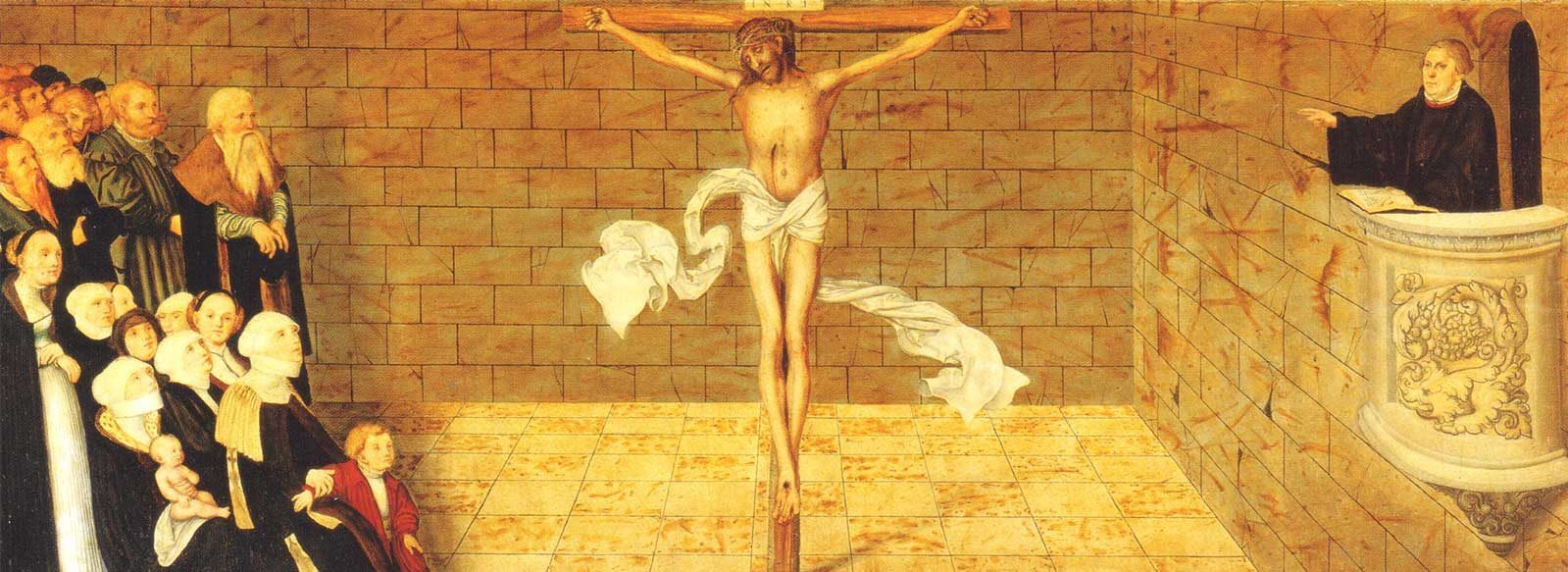
All of which is just to stress what Luther saw as absolutely critical in his debate with Erasmus.  The moment you make the will the centre of gravity, you lose the gospel.  Our wills are bound.  We do what we want, but we can't want the right thing until the LORD sweeps us off our feet.  When He changes our hearts, then the will is liberated to act in line with our new hearts.  But to make our very identity depend on our choices is to commit a fundamental theological error.

I'll write some more on guidance, but for now let's just emphasize this basic point: we are NOT the choices we have made.  We are who we are in Christ who has wooed and won us and freed us to live in a new way.  In that new way there will be decisions to be made. But relax.  Your life and identity is not found in those plans, it's found and it's secure in Christ.

.

More on freedom here.

.

17

I'm preaching through the five solas of the reformation in August.  We're beginning with Christ alone.

So it's

Christ alone

Grace alone

Faith alone

Scripture alone

God's glory alone

So for ten points and control of the next round - can you tell me what Scriptures I should use each week?

And any other things I should say?

Your time starts....

....

....

... now

.

6

...continued from here...

Implications

We've been following the thought of Irenaeus and Athanasius and have seen creation and salvation united as the one divine work of the one divine Word.  Creation is a gospel project for the Gospel God.

Let's sketch out some implications.

Perhaps the first application of these truths should be in the realm of evangelism.  Such a theology of creation and redemption means that the call to “trust Jesus” is not just for Christians.  It is the calling of every creature.  All are to find their peace, their life, their goal in Him.  If, as the Apostle Paul says, “All things are made by [Christ] and for [Christ]” then the question for every creature is, “Am I for Him?”  Christians must have no embarrassment about the greatness of the commission laid upon them for the One they herald is not simply a spiritual Teacher for spiritual people.  He is the Maker and Heir of each one of us.  Pointing to Jesus is not simply a special calling for sprecial Christians but our vocation as human beings.

Secondly, the ‘cultural mandate’ as it's often called ('fill the earth and subdue it', Gen 1:28) is recapitulated in the great commission.  If Irenaeus is right that Adam’s is a ‘sketched out’ ensouled humanity to be filled out by Christ’s spiritual humanity then it is right to see Adam’s commission as similarly recapitulated.  In Matthew 28 Christ, as the Second Adam, tells His people to be fruitful and multiply and fill the earth with the gospel.  “Making disciples” is not a second task alongside a quite separate ‘cultural mandate’.  That would be to assume that God has two works, creation and redemption rather than one work of creation-redemption.  Therefore, making disciples is the renewed and elevated mandate given to new creation people.  This means that care for the environment and socio-political involvement must be strictly co-ordinated under the over-arching requirement of gospel proclamation.  We are to care for this old creation, but we are to do so by pointing to its one hope, Jesus.

Thirdly, the gospel we proclaim needs to be much more comprehensive than the communication of certain moral or spiritual truths.  The gospel is about everything.  In fact, it is the reason for everything.  In ‘pointing to Jesus’ we are not narrowing things down to a small range of religious truths.  Rather we must see how all of history, philosophy, science and the arts, all of created life, is a gospel reality.

Fourthly, we should beware of escapist eschatologies that despise the body and our earthly future.  Our great hope is not some aphysical, anaemic vision of heaven, but of a renewed creation summed up under Christ.  Yet this rightly orients our concern for the environment.  It is not environmentalism that will save the world but Christ Himself.  Our love for the world must take its shape from God’s gospel love for the world.  This will entail a passion for His gospel mission.

Fifthly, we must take seriously our embodied physicality in life.  Our bodies are neither to be despised as unspiritual nor merely indulged or worshipped but they are “instruments for righteousness” (Rom 6:13). More specifically, our gendered embodiment, as part of God’s good creation, is internal to our identity and not something incidental to our personhood.  It is a neo-Gnostic spirituality that would tell us that we are ‘trapped’ in the body of the opposite sex or that a union of bodies is not really a union of persons or that gender is immaterial to such unions.  In modern debates about gender or sexuality, the liberal arguments may present on the surface as a celebration of bodily life.  Yet this is quickly undermined as soon as it is asserted that “my gender or the gender of my partner is immaterial.  What counts is...”  Such arguments are a rejection of our concrete creatureliness in order to ground our true being elsewhere.  It becomes the very opposite of a celebration of bodily life.  We need to return to the more robust doctrine of creation provided by the bishops (the ancient ones, that is).

Seventhly, we must take seriously our embodied physicality in worship.  The evangelical wing of the church will more usually emphasize worship as an all-of-life sacrificial service (Rom 12:1).  This is a right application of the creation-redemption union.  But the catholic wing of the church points with equal and justified concern to a right reverence for the sacraments.  It is not more spiritual to bypass the creaturely gifts of water, bread and wine.  It is not more spiritual to close our eyes and disregard the bodily.  Our spiritual life takes shape precisely in our creatureliness and will do so eternally.  This is not a fact to be lamented but celebrated.  These two wings of the church can help each other to live out the creation-redemption link in worship.

Conclusion

Wherever salvation is spiritualized, wherever the body is denigrated, wherever gender is trivialized, wherever the future is immaterial, wherever the sacraments are Platonized, wherever worship is merely internalized, we have lost the insights of Irenaeus and Athanasius.

Irenaeus must be heard again as he proclaims the triune Creator’s good purposes for this world.  Man ruling under God was the creation blueprint realized in Christ, the Heavenly Man ruling under God in the redeemed creation.  Christ’s work is the triumphant reversal of Adam.  More than this, it is the kingly accomplishment of God’s eternal plan for the creation.  Christ reigns from the tree.

Athanasius must be heard as he holds out Christ as the divine Agent of creation and redemption.  The incarnate work is nothing less than a re-creation of the de-created cosmos disintegrating under the weight of sin and death.  The Redeemer is therefore no-one less than the Creator taking responsibility for His handiwork and making all things new.

When we fail to hold together creation and redemption, Christ’s work is entirely misunderstood.  It is either considered as a superfluous addendum to the purpose of creation or it achieves a goal subordinate to it, or it begins a work alien to the creative intention or, worst of all, it is won as a salvation from the created order (and perhaps even from the Creator).  Yet none of these say what the Scriptures insist and what Irenaeus and Athanasius knew must be proclaimed.  That is, that redemption is the accomplishment of the one work of God, encompassing both creation and redemption.  Christ’s work is not an awkward adjunct but rather the accomplishment and consummation of His own creative intent.

.

For more applications see Dev's recent post.

Here's Leon Sim on Irenaeus and the Trinitarian OT - great stuff.

Dan Hames on Irenaeus.

And Mike Reeves' introductions to Irenaeus and Athanasius
.


.

.

...continued from here...

Is salvation achieved merely by the incarnation?

Both Irenaeus and Athanasius are commonly accused of making the ‘bare fact’ of incarnation the sum total of Christ’s saving work.  Yet this is unfair.

For Irenaeus, Christ’s filling out of Adam’s distorted image means necessarily a “filling up [of] the times of his disobedience” (Ad. Her. III.21.1)  In taking on Adam’s substance, He took on Adam’s curse – this He satisfied at the cross, ‘propitiating indeed for us the Father, against Whom we had sinned’ (Ad. Her. V.17.1) and ‘redeeming us by His own blood’ (Ad. Her. V.14.3).  Having put Adam to death, the resurrection then realizes Christ’s spiritual body bringing about the true glorified humanity to which the redeemed will belong and on which the renewed creation will be patterned.

Athanasius calls the cross "the very centre of our faith."  For him, the curse of death is a key consideration.  Within the creation narratives comes God's decree: "You will surely die."  The word of Genesis 2:17 must be maintained lest God be proved false and, ironically, the serpent proved true.  Christ’s incarnation is therefore that by which the Word can take a body capable of death “so that in His death all might die, and the law of death thereby be abolished." (De incarn. 8) Moreover this death is specifically a sacrifice (De. Incarn. 9; 10; 20) made under God’s curse (De incarn. 25) and offered without blemish (De. Incarn. 9) so as to be a ransom (De. Incarn. 9; 25) freeing us from Adam’s ‘primal transgression’.  “In the same act also He showed Himself mightier than death, displaying His own body incorruptible as the first-fruits of the resurrection.”

Thus, while the Bishops both see the union of divine and human as the goal of God’s creation-redemption purposes; and while the ‘Word become flesh’ is their sole hope for this union; the ‘bare fact’ will not do on its own. The nature of Adam’s race requires much work to be done.  Mankind must turn from idols to the Truth, we must receive and truly own an active righteousness before the Father, Satan has to be defeated, justice must be upheld, sin must be dealt with, incorruptibility must be won.  Thus, Christ’s divine teaching, His demonstrations of authority over man, nature and the devil, His active obedience, His suffering, His death, His resurrection and His ascension are all crucial in order to accomplish redemption.

Yet, against those (especially the Arians), who would uphold the necessity of these works yet deny the Person who worked them, it must be maintained that the Agent of these works is God and the locus of their working is man.  These works are, therefore, only effective because they are the works of the God-Man.  Thus, the incarnation is the necessary cause of redemption, but sufficient only when articulated as the full work of the Incarnate, Creator-Word.

In the final post I'll draw out some implications for today...

.

...continued from here...

The Fall - the Need for Re-Creation

In the philosophies of the third and fourth centuries, creation came out of great ruptures (e.g. wars in heaven).  Against this, Athanasius maintained that physicality is not the issue for the creature before God.  The problem – that is, the fall – occurs after creation.  Thus it is humanity’s disobedience that gives rise to the rupture between God and man: an ethical rather than ontological problem.

The fall was a rejection of the Word, in consequence of which mankind no longer knew God and instead pursued false images (idols), not the true Image.Since God’s intention for creation is His fellowship with man in His Image, then this disruption affects the whole cosmos.  The fall is thus ‘the work of God… being undone’ - de-creation.

Time and again Athanasius stresses how ‘supremely unfitting’ and ‘unthinkable’ it would be for the ‘All Good’ ‘Father of Truth’ to allow His creation to run such a ruinous path.  He also notes that humanity has no resources within itself to remedy the situation.  Thus God’s commitment to creation demands a reversal of the fall.  Without redemption, God’s “consistency of character with all” is compromised.  Or as Irenaeus had said, God must act lest He “be conquered [and] His wisdom lessened.” Since the fall was a ‘de-creation’ so redemption must be a re-creation.  And if this is so, then the Creator Himself must be the Redeemer.  Thus, creation and redemption are held together by the One Divine Word.

The Fall - the Need for Recapitulation

Where Athanasius speaks of re-creation, Irenaeus speaks of recapitulation.

Recapitulation (anakephalaiosis; see especially Ephesians 1:10; also Romans 13:9) has been variously understood: to sum up, to go over the same ground again, to unite under a single head, to restore to the original, to bring to a climax.  All of these capture something of Irenaeus’ meaning though I prefer the picture of 'a spiral climb'.  It means going over the same ground but thereby raising it to a higher plane.  Fundamentally, redemption is described as God “recapitulating in Himself His own handiwork." (Adv.H., III.22.1)

Thus “what we had lost in Adam – namely, to be according to the image and likeness of God – that we might recover in Christ Jesus.” (Adv. H., III.18.1)  Christ achieves this by taking the very flesh of Adam (Adv. H. V.1.3) – the head of the old humanity – and, going over the ground of Adam’s history.  E.g:

just as Adam had no earthly father, so too Christ (III.18.7); just as Eve was disobedient, so Mary is obedient (V.19.1); just as Adam was tempted through food and failed, so Christ was tempted through fasting and succeeded (V.21.2); just as Adam was disobedient with the tree, so Christ is obedient on the tree (V.16.3) etc. etc.

Christ achieves victory where Adam failed.

“He has therefore, in His work of recapitulation, summed up all things… in order that, as our species went down to death through a vanquished man, so we may ascend to life through a victorious one; and as through a man death received the palm [of victory] against us, so again by a man we may receive the palm against death.” Adv. H. V.21.1

Thus Christ can become the Head of the true spiritual humanity to which we must belong. This is, of course, not an innovation of Irenaeus’, but the plain teaching of the Scriptures –  Romans 5:12-21; 1 Corinthians 15:20-22, 44-50.

What's important for out purposes is the fact that God’s creative work has moved in this direction from the beginning.  Adam is always heading towards Christ.  Eden is always heading towards the New Jerusalem, etc, etc.  Christ’s incarnate work is completely ‘of-a-piece’ with His creation.  The goal of all God’s ways with the creation has ever been to sum up everything under the Heavenly Man, Christ (Eph 1:10)

Thus, the humanity of Adam, for Irenaeus, was ‘sketched out’ expressly as that which must be filled out by Christ.

“The Word – the Creator of all – prefigured in Adam the future economy of His own incarnation.  God first sketched out the ensouled human being, with a view to his being saved by the spiritual human being.  Since the Saviour was already in existence, the one who was to be saved had to come into existence, or the Saviour would have been Saviour of no one." (Adv.H. III.22.3)

Notice that Adam was always 'to be saved' and that Christ is ‘Saviour’ even before the fall.  Thus Minns must be right when he says of Irenaeus’ theology:

“Adam’s sin conditions the salvation to be worked by the incarnate Word but it does not call it into existence.  For the earth creature does not come to be in the image and likeness of God until God becomes flesh, until the human being in whose image Adam was created stands on the earth.” (D. Minns, Irenaeus,  p87)

For Irenaeus, Christ’s work is not simply the answer to sin (though it certainly accomplished this).  Christ’s incarnate work inhabits and realizes the one dynamic story of creation’s fulfilment moving from Adam to Christ, from flesh to spirit, from Eden to the New Jerusalem.  Salvation is not a response to the fall and it's not paradise restored.  Salvation is the drawing into God of what has been made through the Son.  And what has been made has always been destined for this redemption.

Thus, creation and redemption are not just held together by One Divine Word, they are also held together as one divine work.

CONTINUED HERE

2

...continued from here...

The purpose of creation

In a key passage of De Incarnatione, Athanasius defines the purpose of creation:

…why should God have made them at all, if He had not intended them to know Him? But, in fact, the good God has given them a share in His own Image, that is, in our Lord Jesus Christ, and has made even themselves after the same Image and Likeness. Why? … [so that] they may be able to perceive the Image Absolute, that is the Word Himself, and through Him to apprehend the Father; which knowledge of their Maker is for men the only really happy and blessed life. (De incarn. 11)

The creature is willed by God out of His abundant goodness as the overflow of His triune life.

It is absolutely foundational to Athanasius’ doctrine of God that He is ‘good’.  On the Incarnation abounds with the ‘goodness’ and ‘sheer goodness’ of the ‘All-good God.’ E.g.:

For God is good—or rather, of all goodness He is Fountainhead, and it is impossible for one who is good to be mean or grudging about anything. Grudging existence to none therefore, He made all things out of nothing through His own Word, our Lord Jesus Christ. (De. Incarn. 3)

Athanasius' doctrine of God is a decidedly happy one!

Therefore from God's overflowing goodness, He does not will to be God alone.  And so the creature is brought into being, not in independence but in happy dependence to know God.  As one made after the true Image – the eternal Word – the proper destiny of man is to participate in the divine life.  Man, in union with Christ – who is "Man among men" – is to be taken up to the Father, by the Spirit, and so to participate in God.

This participation is described variously by the two:

For Irenaeus it's ‘passing into God’ (Adv. H., IV. 33.4.); being ‘promoted into God’ (Adv. H., III.19.1.).  And most famously he says:

Our Lord Jesus Christ… did, through His transcendent love, become what we are, that He might bring us to be even what He is Himself. (Adv. H., V. pref.)

For Athanasius:

He, indeed, assumed humanity that we might become God.’ (De incarn., 54);

The Word became flesh in order both to offer this sacrifice and that we, participating in His Spirit, might be deified. (De Decret., ch 14)

What is the essence of this participation in God?  Obviously neither of the Bishops could speak of this deification in ethereal ways.  For theologians who look to Christ to see the fullness of deity, 'becoming God' couldn't possibly mean becoming less human.  Any more than Christ's becoming Man meant His becoming less God!  No, participation in God is not about dissolving into a divine stuff.  It's about participating in the relationships of the trinity - being loved by the Father in the Son and through the Spirit.

Listen to Irenaeus explain deification:

“Those who receive and bear the Spirit of God are led to the Word, that is to the Son.  But the Son takes them up and presents them to the Father, and the Father bestows incorruptibility.  Therefore one cannot see the Word of God without the Spirit, nor can anyone approach the Father without the Son.  For the Son is the knowledge of the Father, and knowledge of the Son of God is through the Holy Spirit.  But the Son, in accord with the Father’s good pleasure, graciously dispenses the Spirit to those to whom the Father wills it, and as the Father wills it.” (Demonstration. 7)

Participation in God does not mean participation in some omni-being of attributes.  It means being properly related to our triune Creator.

Creation has come out of the triune love of God and its goal is to be drawn back in.  Not in dissolution we must add.  Creation remains truly itself as it participates in the love that birthed it.  As all things are drawn by the Spirit under the feet of Christ, the world maintains - and actually achieves - its concrete otherness because the love of God does not dissolve but affirms distinction and difference.

But this is the goal of creation – many brought into God in the Son.

In the heresies we have met, the divine could not be divine in its engagement with the creation.  Nor could the creature attain to the divine without escaping the created.  Yet the Triune LORD’s relationship to the creation allows the Eternal Word to be Himself even as He works immanently in, with and through His world.  And we can truly participate in this triune God even as we live our creaturely lives.  We can be truly spiritual and truly physical all at once without falling off one side of the horse or the other.

The fall, though, threatens to thwart God’s goal.

CONTINUED HERE

...continued from here...

Creation

Where has creation come from?  There are three popular options.

1) Maybe it's come out of some problem in the heavenly realms.  Perhaps it's the body of a slain monster as in the Babylonian myth Enuma Elish - literally a monstrosity.  Perhaps, as the Gnostics would have it, creation arises after a member of the spiritual realm has been sin-binned for some misdemeanor.  Again, this being who is outside the spiritual constitutes creation.  Perhaps - a popular one today - it's arisen from explosions and endless struggle.  In these variations on a theme the underlying belief is that fall precedes creation and gives rise to it.

2) Another option is to say that creation has always existed.  It's just an immovable, eternal fact - godlike in its own right.  Here, if you believe in God, he's got his hands tied and basically does his best with the materials available.

3) A third option is to say creation is a matter of the will.  There is first a God (or some power or principle), and creation exists alongside as a demonstration of his power.  To get to the heart of all things is not to find a heart at all but only force.

Interestingly our modern creation myth is a synthesis of all these errors.  We are the result of explosions, chaos, death and struggle; God (if he exists) is a far-off clockmaker and really the only way to live in such a world is to acknowledge that might is right and propagate our selfish genes.

But there is another way to see creation.  And the trinity is crucial.

As Irenaeus and Athanasius saw it, the Father of all was first Father of the Son Whom He loves.  And this Father-Son love in the Spirit provides the key to understanding creation rightly.  Robert Jenson puts it well:

The Father’s love of the Son is... the possibility of creation.  Insofar as to be a creature is to be other than God, we may say that the Father’s love of the Son as other than himself is the possibility of creation’s otherness from God. (R.Jenson: Systematic Theology, vol 2, p48.)

The massive significance of this can be seen when we ask the question, what is it like to be 'other' than God?

With option 1) above, to be other than God is to be a cosmic embarrassment, the fruit of a defect.  With option 2) to be other than God means to be a cog in an impersonal machine.  With option 3) to be other than God is to be a slave.  But with the triune God, to be Other than God is to be beloved and included.

In eternity the Son has been Other to God.  He is the Father's eternal complement as Body to Head (1 Cor 11:3).  Otherness is therefore not competitive or defective but corresponding and desired.  And creation that is in Christ and through Christ and for Christ is the extension of this eternal love-for-otherness.  Colin Gunton says:

To create in the Son means to create by the mediation of the One who is the way of God out into that which is not Himself.  (Triune Creator, p144)

Before creation there was not nothing and there were not wars, there was a Loving Father eternally anointing His Son in the Spirit.  And as Irenaeus has said, that Son is called Christ "since through Him the Father anoints and adorns all things." (Demonstration §53)

That's worth meditating on!

For Irenaeus, even our individual formation in the womb comes through Christ.  (Ad. Her. IV.31.2; V.15.3)

The Father of Jesus brought all things into existence from nothing through His two hands – the Son and the Spirit, His Word and Wisdom.

For the hands of God in Scripture see, for e.g. Isaiah 48:13, 51:9; Psalm 98:1; Ezekiel 3:14,16; Daniel 5:5; 10:10f; Matthew 12:28; Luke 11:20.

So Irenaeus says:

This hand of God which formed us at the beginning, and which does form us in the womb, has in the last times sought us out who were lost, winning back His own, and taking up the lost sheep upon His shoulders, and with joy restoring it to the fold of life.  (Ad. Her. V.15.2);

And, because God is rational, he therefore created what is made by his Word, and, as God is Spirit, so he disposed everything by his Spirit. (Demonstration. 5.);

For with Him were always present the Word and Wisdom, the Son and the Spirit, by whom and in whom, freely and spontaneously, He made all things. (Ad. Her. IV.20.1)

On all these points, Athanasius was in agreement.

The key advance which Athanasius made with regard to a Christological doctrine of creation was his definitive differentiation between the Son’s eternal generation from the Father and creation’s in-time manufacture.  Irenaeus would surely have agreed with Athanasius on these points but he didn't have an Arius forcing him to articulate his position in quite the same way.

The issue arose because for Arius the world was willed by a God who is not essentially Father and therefore not essentially Lover.  The world is a product of will.  And Christ too is the off-shoot of this will since he must be made as a demi-god mediator in order to (somehow!) bridge the infinite otherness-gap of God and creation.  All of this is the absurdity of unitarianism.  Yet it was Arius who found trinitarian thinking absurd.

He would ask Athanasius, "Why do you say there was a time when creation began to exist, but not a time when the Son began to exist? What convincing distinction can be made between begetting and making?"

Athanasius answers that there is a crucial distinction between what is begotten and what is willed.  Paternity is a matter of essence, not will. As soon as a father has a son he is a father.  Therefore the Father has always been Father just as the Son has always existed.  Yet creating is a matter of will not essence – one can be a maker before one actually makes.  Therefore, just because God has always been Maker does not mean that there has always been something that is made (i.e. creation).

So creation has a beginning in time but the Son does not.  Jesus is the Father’s Son by nature (or essence), creation is God’s handiwork by will. He is Begotten not Made as the creed now says.

But here's the good bit - the Father has willed a commitment to the creation that is very much tied to His essential commitment to the Son.  The creature is lovingly and purposefully willed by the Father as that which is ‘after’ His eternal Image Whom He loves. His love for the creature corresponds to His love for the Son, for when He beholds the creation He delights ‘in seeing the works made after His own Image; even this rejoicing of God is on account of His own Image.’ (Contra Arianus. II.82)

Because of the mediation of the Son, creation could never be a matter of indifference to the Father.  The love with which He has loved the Son is now bound up in the world He has made for Him.  But precisely because it is for Him then Athanasius has successfully reversed Arius’ heretical proposition:

It is not He who was created for us, but we are created for Him. (Contra Arianus, II.31)

A properly trinitarian account of creation has therefore preserved the honour of Christ as Divine Creator but also the honour of the world as beloved creature.

Where have we gotten to?

I do not live in a monstrous reality arising from chaos.  I don't live in a grand, impersonal machine.  And I don't exist for the magnification of might.  I am from the Father, created purposefully out of His overflowing love through the Son, and - by the Spirit - for Him.

It's that "for Him" that's we'll discuss next time.  We will consider the purpose for creation.

CONTINUED HERE

.
Twitter widget by Rimon Habib - BuddyPress Expert Developer