Skip to content

I recently re-read Nathan Pitchford's excellent short article on the reformers' hermeneutic.

His basic point is that Sola Scriptura always leads to Solus Christus.  The literal reading simply is the christocentric reading.

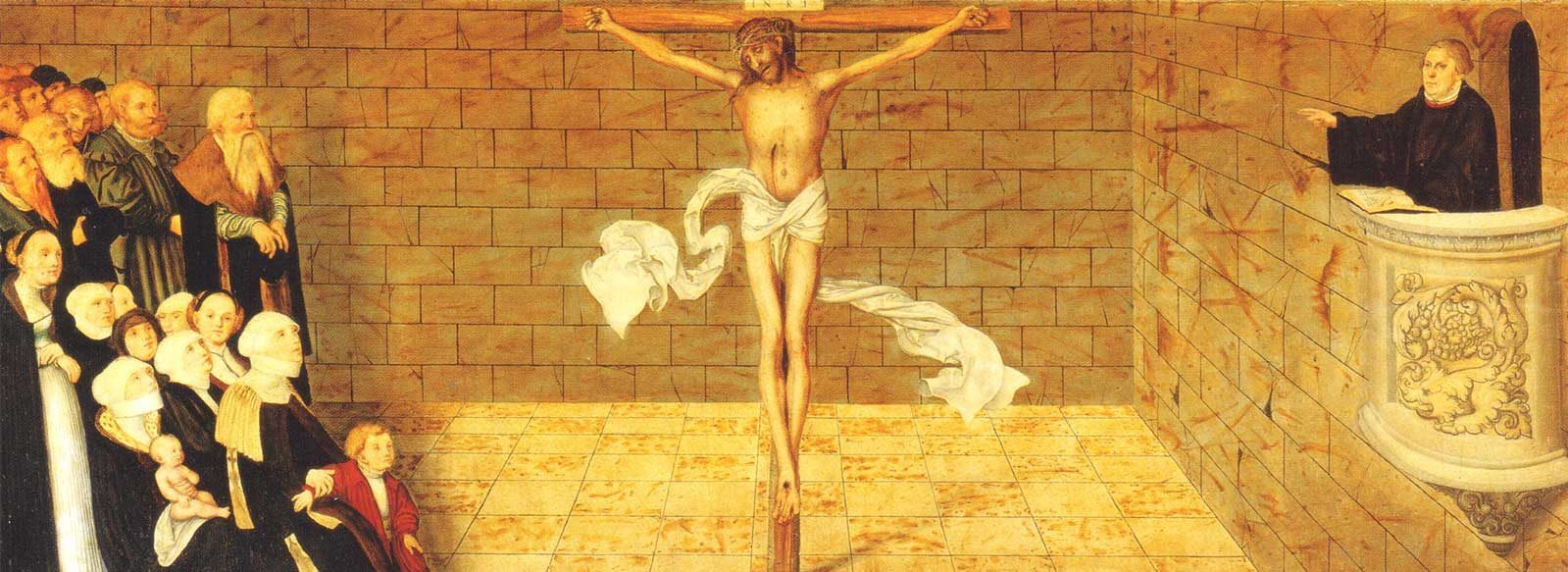
For Luther, the grammatical-historical hermeneutic was simply the interpretation of scripture that “drives home Christ.” As he once expressed it, “He who would read the Bible must simply take heed that he does not err, for the Scripture may permit itself to be stretched and led, but let no one lead it according to his own inclinations but let him lead it to its source, that is, the cross of Christ. Then he will surely strike the center.” To read the scriptures with a grammatical-historical sense is nothing other than to read them with Christ at the center.

And yet, claims Pitchford, many evangelicals today have a basically un-Christian reading of the OT.

[What I mean is]...  they employ a hermeneutic that does not have as its goal to trace every verse to its ultimate reference point: the cross of Christ. All of creation, history, and reality was designed for the purpose of the unveiling and glorification of the triune God, by means of the work of redemption accomplished by the Lamb slain from the foundation of the world. The bible is simply the book that tells us how to see Christ and his cross at the center of everything. It tells us who God is by showing us the person and work of Christ, who alone reveals the invisible God. If we do not intentionally ask ourselves, “How may I see Christ more clearly by this passage,” in our reading of every verse of scripture, then we are not operating under the guidance of Luther’s grammatical-historical hermeneutic. If we would follow in the steps of the reformers, we must realize that a literal reading of scriptures does not mean a naturalistic reading. A naturalistic reading says that the full extent of meaning in the account of Moses’ striking the rock is apprehended in understanding the historical event. The literal reading, in the Christ-centered sense of the Reformation, recognizes that this historical account is meaningless to us until we understand how the God of history was using it to reveal Christ to his people. The naturalistic reading of the Song of Solomon is content with the observation that it speaks of the marital-bliss of Solomon and his wife; the literal reading of the reformers recognizes that it has ultimately to do with the marital bliss between Christ and his bride, the Church. And so we could continue, citing example after example from the Old Testament.
 

So what went wrong?  How come the reformers' understanding of a "literal hermeneutic" gets used today to justify un -Christian interpretation?  Well, historically the influence of academic liberalism turned 'the literal reading' into 'the naturalistic reading'.  And that's quite a different thing. 

Nathan ends with 6 points at which the naturalistic reading fails:

1. A naturalistic hermeneutic effectively denies God’s ultimate authorship of the bible, by giving practical precedence to human authorial intent.

2. A naturalistic hermeneutic undercuts the typological significance which often inheres in the one story that God is telling in the bible (see Galatians 4:21-31, for example).

3. A naturalistic hermeneutic does not allow for Paul’s assertion that a natural man cannot know the spiritual things which the Holy Spirit teaches in the bible – that is, the things about Jesus Christ and him crucified (I Corinthians 2).

4. A naturalistic hermeneutic is at odds with the clear example of the New Testament authors and apostles as they interpret the Old Testament (cf. Peter’s sermon in Acts 2, Paul’s interpretations in Romans 4 and Galatians 4, James’ citing of Amos 9 during the Jerusalem council of Acts 15, the various Old Testament usages in Hebrews, etc.).

5. A naturalistic hermeneutic disallows a full-orbed operation of the analogy of faith principle of the Reformation, by its insistence that every text demands a reading “on its own terms”.

6. A naturalistic hermeneutic does not allow for everything to have its ultimate reference point in Christ, and is in direct opposition to Ephesians 1:10, Colossians 1:16-18, and Christ’s own teachings in John 5:39, Luke 24:25-27.

.

Really great stuff, go read the whole thing.

.

The excellent Marc Lloyd has posted the juciest quotation on Christ the Mediator of all revelation.  It's from Ronald Wallace's book Calvin's Doctrine of Word and Sacrament.  Here he is summarizing Calvin's view especially of christocentric revelation in the OT.

The Mediator of all revelation between God and man in the Old Testament is the Word of God, the second person of the Trinity, the same Christ who became incarnate in Jesus of Nazareth. Throughout the whole national history of Israel, it was always He, the Son of God, who dealt with His people in judgement and mercy, bringing them, with His Presence in their midst, light and life and salvation. Calvin asserts positively that Christ, the Word of God, who "remains with God perpetually one and the same and who is God Himself" (Inst 1:13:7), was "always the bond of connection between God and man" (Comm on Gen 48:15), and "the source of all revelations" (Inst 1:13:7), being "always present in all the oracles" (Comm on Gen 16:10). He is equally emphatic in the frequent negative assertion, "Never did God reveal Himself outside of Christ" (Comm on Jn 5:23). "Nor indeed, had any of the saints ever had communication with God except through the promised Mediator." (Comm on Ex 3:2) "God formerly manifested Himself in no other way than though Him." (Comm on Gen 48:15) God never otherwise revealed Himself to the Fathers "but in His eternal Word and only begotten Son" (Comm on Is 6:1). The whole story of the Old Testament is thus the story of how Christ, the Word of God, breaks in upon the life of those whom He has chosen to make his people, and confronts them in these veiled forms through which they can come to know His nature and have communion with Him....

The frequent appearances of the "Angel of the Lord" as the representative of God to the Old Testemant Fathers, and as a guide of the people throughout their history is a sign that Christ is always fulfilling His Mediatorial office of saviour and revealer, and uniting even then the members of His Church to Himself as the Head through whom they are joined to God Himself. Calvin, following the "orthodox doctors" (Inst 1:13:10) on this point, identifies the "chief angel" who appears among the other angelic visitors to earth with "God's only begotten Son who was afterwards manifest in the flesh" (Comm on Ex 14:19). Even then He performed in a preliminary fashion "some services introductory to His execution of the office of Mediator" (Inst 1:13:10). "There is then no wonder," says Calvin, "that the Prophet should indictriminately call Him Angel and Jehovah, He being the Mediator of the Church and also God. He is God, being of the same essence with the Father; and Mediator, having already undertaken His Mediatorial office, though not then clothed in our flesh so as to become our brother; for the Church could not exist nor be united to God without a Head" (Comm on Zech 1:18-21). "The angel who appeared at first to Moses, and was always present with the people during their journeying, is frequently called Jehovah. Let is then regard it as a settled point that the angel was Son of God, and was even then the Guide of the Church of which He was the Head" (Comm on 1 Cor 10:9).

Calvin’s Doctrine of the Word and Sacrament (Edinburgh, Scottish Academic Press, 1995) first edition 1953, pp8-10


I bang the same drum (endlessly) here.  For more quotes in support from the big guns go here.  Or read Bible Overview, especially appendix 2.

.


Justin Taylor points us to a very helpful book review by Andy Naselli, whose blog looks great!  What follows is taken straight from Andy's blog - do check it out for yourself.

Three views on the New Testament use of the Old Testament outlines the following three positions:

Walter Kaiser Jr: “Single Meaning, Unified Referents: Accurate and Authoritative Citations of the Old Testament by the New Testament”

Darrell L Bock: “Single Meaning, Multiple Contexts and Referents: The New Testament’s Legitimate, Accurate, and Multifaceted Use of the Old”  

Peter Enns: “Fuller Meaning, Single Goal: A Christotelic Approach to the New Testament Use of the Old in Its First-Century Interpretive Environment”  


The book orbits around five key questions:

  1. Is sensus plenior an appropriate way of explaining the NT use of the OT?
  2. How is typology best understood?
  3. Do the NT writers take into account the context of the passages they cite?
  4. Does the NT writers’ use of Jewish exegetical methods explain the NT use of the OT?
  5. Are we able to replicate the exegetical and hermeneutical approaches to the OT that we find in the writings of the NT?

And the general editor, Kenneth Berding, helpfully tabulates a summary of their answers:


Kaiser

Bock

Enns

Sensus plenior?


No, the prophets knew where their prophecies were heading.


Yes, but only in the limited sense of acknowledging that the OT writers could not always see fulfillments that emerge later.


Yes, because Christ-as-telos holds it all together. This, however, is not the way to resolve the “hermeneutical tension.”

Typology?


Yes, but it must be seen ahead of time and possess “divine indication” that it is a type.


Yes, and fundamental for resolving difficult cases; can be either prospective or retrospective.


Yes, but again not the way to resolve the hermeneutical tension.

Context?


Yes, both the immediately literary context and the antecedent “promise-plan” context are important.


Yes, the immediate “exegetical context” is drawn upon but the “canonical context” is the key.


Sometimes yes and sometimes no.

Use of Second Temple exegetical methods?


No, such comparisons are misguided.


Sometimes yes, but constrained by the NT authors’ commitment to canonical reading.


Yes, and this is the central issue in the discussion.

Replication?

Yes, because the NT authors are careful interpreters just as we should be. Yes, but particularly in terms of their overall appeal to canonical themes. Yes, but less in terms of their exegetical methods and more in terms of their “Christotelic” goal.

.

Though I've not read the book, the first comment on Andy's blog puts well my gut reactions to this issue:


From Tom Keiser:

One thing consistently missing, or at best, minimalized, is the question of the proper exegesis of the OT texts. Kaiser seems to best deal with this idea, although not always directly. The tendency is to see OT exegesis as primarily historical. Little consideration seems to be given to the possibility that OT writers were speaking primarily theologically, and applying theological principles to historical situations. If that is the case, than proper exegesis should be focusing on the theological ideas presented rather than simply their historical application. This perspective has profound implications when trying to ascertain the NT writers’ understanding of the OT. If they understood the OT texts as presenting primarily theological principles, then many of their applications to Christ would no longer be problematic, but rather reflect accurate “historical-grammatical” exegesis. Of course, this consideration does not resolve all issues, but does alleviate many tensions.

.

5

Who said the appendix is redundant?  There's some brilliant appendices to Bible Overview

How about this from Paul Blackham - he answers 24 frequently asked questions about an explicitly Christ focused Old Testament.  Here are the questions - if you want to read his answers - buy the book!

Appendix I - Frequently Asked Questions (Written by Paul Blackham)

 1. Do we need the New Testament?  If the gospel was set out in the Old Testament and the ancient church was saved by that revelation, then is the New Testament ultimately necessary?

 2. Weren't the writers of the Old Testament trying to work out what they had written, according to 1 Peter 1:10-12?

 3. Did the writers of the Hebrew Scriptures understand what they were writing?

 4. How much did the Old Testament saints really know about the person and work of Jesus Christ?

 5. According to Hebrews 1:1-3, didn't God have a different revelation in the Old Testament?

 6. If the Old Testament church knew so much, what was the point of the incarnation?

 7. What difference did the incarnation make to God the Son? How did the incarnation affect Him?

 8. In Hebrews 11:40 doesn't it seem as if the Old Testament church was imperfect until the New Testament church came along?

 9. According to Exodus 6:2-3, did Abraham know the name of the Lord?

 10. When Jeremiah spoke about a ‘new covenant' was he looking forward to a different way of salvation?

 11. What are the differences between the church in the Old Testament and the church in the New Testament?  What are the areas of continuity and discontinuity?

 12. We just speak about ‘Jesus' all the time, but what name did the Old Testament saints use to refer to God the Son?

 13. What is the meaning of the day of Pentecost in Acts 2?  Is it ‘the birth of the church' or perhaps ‘the coming of the Spirit'?

 14. Why does Paul speak about the ‘mystery' that was not revealed to people in the past as it has now been revealed in the New Testament?

 15. Why do so many Christians think that the Angel of the Lord is God the Son?

 16. Is the Word of the Lord in the Old Testament the same as the Word of God in John 1?  Is the Word of the Lord a title for Jesus in the Old Testament?

 17. Are we in a more privileged position today than the Old Testament saints?

 18. Is the revelation of God ‘progressive'?

 19. In Matthew 11:11, doesn't Jesus say that even the least New Testament Christian is greater than the greatest Old Testament prophet, John the Baptist?

 20. Can the gospel of Christ really be understood from the Old Testament as well as the New Testament?

 21. Did every believer in the Old Testament have a personal meeting with the Angel of the Lord?

 22. How can we speak of the ‘church' in the Old Testament when that word is never used in the Old Testament?

 23. Why did the early church think that Jesus was in Proverbs 8?

 24. Do all Christians understand the Old Testament in this way?


This is followed, in appendix 2, by a list of quotes from the greats of church history.  All of them uphold conscious faith in Christ from the very beginning:

JC Ryle
CH Spurgeon
RM McCheyne
John Newton
George Whitfield
Jonathan Edwards
John Bunyan
Richard Sibbes
John Owen
Francis Turretin
The Geneva Bible notes
Church of England homilies (1562)
John Calvin
Martin Luther
Cyril
Leo the Great
Jerome
Augustine
Ambrose
Chrysostom
Eusebius Pamphilius
Tertullian
Clement of Alexandria
Irenaeus
Justin Martyr
Igniatius

.That's some cloud of witnesses eh?

.

Go buy this book.


Okay it's one of the least inspiring book titles ever conceived, but it does exactly what it says on the front.

Steve Levy has written it with Paul Blackham.  It's 336 pages.  There are 11 sections:

What the Bible says about itself

Creation to new creation

Father Abraham

Redemption

Promised Land

Kings to Exile

Latter Prophets

The Writings

The gospels

Acts and the church

The church in Revelation


Loving what I've read so far.  I reckon this is the book I'll be giving to anyone wanting a grounding in Christ-focused biblical theology.

Here's a provocative paragraph early on:

"When you are reading any of the Old Testament books, whether Numbers, Leviticus, Kings or Chronicles, you are reading about the gospel of Jesus Christ.  You are not reading an illustration of the gospel, you are not reading stories that can be reinterpreted in the light of the gospel.  You are reading God's clear word about Jesus.  That is how the Bible sees itself."  (p22) 

I'm sure I'll be posting quotes as I go.  But seriously - go and buy this book!

.

These are a few scattered thoughts prompted by my recent mini-series on parables.

We all know Jesus' rebuke regarding Old Testament understanding - John 5:39ff.  Yet I'm sure a rebuke remains for our appreciation of the New:

You diligently study the New Testament thinking that now you're breathing the free air of apostolic Christianity and therefore, definitionally, have life.  But the point of these Scriptures (as with all Scripture) is witness to me.  Yet you neglect to come to Me for life.

New Testament does not mean 'gospel'.  It doesn't mean 'gospel' any more than Old Testament means 'gospel'.  Rather, both are witnesses to Christ.

You see it's not the New Testament that fulfils the Old

 No.  It is not the NT that fulfils the Old. It's Jesus.  There's a difference.  It's He that stands above both Scriptures.

There's nothing inherent in the Greek Scriptures that the Hebrew Scriptures lack.  The point of both - Christ Himself - stands ever above both Old and New Testament.  Life does not exist in the Old Testament.  But life does not exist in the New Testament either.

This is one of the problems with the saying: 'The New is in the Old concealed, the Old is in the New revealed.'  It easily lends itself to the thought that the New Testament itself is the fulfilment of the Old.  But no, Christ is the fulfilment of the Old.  And He's the fulfilment of the New.  The Old is in need of fulfilment in Christ yes.  But so is the New.  To understand Old or New demands that we read them as witness to Jesus.

We've been taught to pick a Christ-less Old Testament sermon from a mile off.  Yet we put up with Christ-less New Testament study much more readily.  How can that be unless we secretly believe life really does exist in the Scriptures - we just happen to prefer the Greek ones?

.

3

In response to my Christ in the OT posts, Pete Myers posted this.  We then interacted here and here.

I then posted these ten propositions on Trinity, revelation and the Old Testament:

.

1.  Revelation in Christ is revelation in the distinct Person of the Divine Mediator

.

2. Our doctrine of God goes awry if we begin without a conscious acknowledgement of the triune interplay.  God’s attributes are a spin-off of the triune life, not the identical CV of each Person. 

.

3. There is no such thing as pre-supposition-less exegesis. 

.

4. The trinity is not a proposition to be revealed about the living God.  Trinity is not one more truth among other divine truths.  Trinity is who He is and the dynamic by which all revelation occurs.

.

5. In its own context and on its own terms the OT must be understood as a dynamic multi-Personal revelation.  OT saints who failed to see this did not ‘partially understand’ the revelation - they misunderstood it.

.

6. The Angel of the LORD is the pre-incarnate Christ.  His identity as God from God is as clear in the OT as His incarnate identity is in the New.

.

7.  Psalm 45 is a good example of a Scripture that assumes a multi-Personal doctrine of God even in its own context.

.

8. The administration of Gentile inclusion is not a ‘model’ of progressive revelation.  The administration of Gentile inclusion is the new thing.

.

9.  Calvin and Owen believed in divine simplicity.  (I have serious reservations about the doctrine - see here But they managed to avoid the more dangerous aspects of it because they insisted upon Christ-mediated revelation. 

.

10. The One is not more ultimate than the Three.  Neither is the immanent something different to what we see in the economic. 

.

You may know that I (sporadically but vigourously!) bang the drum for Christ the eternal Mediator being the deliberately revealed, consciously known object of faith in the Old Testament.  Here are some posts on the issue.

Pete Myers read it and posted this.  And our further discussions are here and here.

By way of some kind of response, here are ten propositions that circle around some of the issues. (Fabricius eat your heart out). 

For those yawning right now, hold on for some grand hilarity next week - I'm on holidays and will post only frivolity.  For those fixing to flex their theological muscles, remember to play nice.

.

1.  Revelation in Christ is revelation in the distinct Person of the Divine Mediator

.

.

...continue reading "Trinity, revelation and OT – 1"

You may know that I (sporadically but vigourously!) bang the drum for Christ the eternal Mediator being the deliberately revealed, consciously known object of faith in the Old Testament.  Here are some posts on the issue.

Pete Myers read it and posted this.  And our further discussions are here and here.

By way of some kind of response, here are ten propositions that circle around some of the issues. (Fabricius eat your heart out). 

For those yawning right now, hold on for some grand hilarity next week - I'm on holidays and will post only frivolity.  For those fixing to flex their theological muscles, remember to play nice.

.

2. Our doctrine of God goes awry if we begin without a conscious acknowledgement of the triune interplay.  God's attributes are a spin-off of the triune life, not the identical CV of each Person. 

.

.

...continue reading "Trinity, revelation and OT – 2"

You may know that I (sporadically but vigourously!) bang the drum for Christ the eternal Mediator being the deliberately revealed, consciously known object of faith in the Old Testament.  Here are some posts on the issue.

Pete Myers read it and posted this.  And our further discussions are here and here.

By way of some kind of response, here are ten propositions that circle around some of the issues. (Fabricius eat your heart out). 

For those yawning right now, hold on for some grand hilarity next week - I'm on holidays and will post only frivolity.  For those fixing to flex their theological muscles, remember to play nice.

.

3. There is no such thing as pre-supposition-less exegesis. 

.

...continue reading "Trinity, revelation and OT – 3"

Twitter widget by Rimon Habib - BuddyPress Expert Developer