Do you get your words all mixed up when you speak of Jesus? That's so much better than being slick.

Jesus is the Word of God

Do you get your words all mixed up when you speak of Jesus? That's so much better than being slick.
There are none so blind as those who will not see. And none so gullible as those who will not believe.
Exhibit A: Here's Stephen Fry spouting absolute bunkum for two and a half minutes:
He sets himself up as the sceptic to debunk the religious. In fact he is the sucker, falling for a completely discredited copy-cat theory with not an ounce of truth to it. Here's a good take-down by Lutheran Satire:
In a show that seeks to explode popular myths, why does Fry fall for one in such spectacular fashion? Might it be that he's not actually as sceptical as he likes to think? Might it be that the commitments of his heart do the "thinking" for him?
Exhibit B: This post, supposedly reporting new liberal views from the Pope, is from Diversity Chronicle, a site which claims "The original content on this blog is largely satirical." It's supposedly a statement from "Vatican 3" which declares all religions true, etc, etc.
It has been shared tens of thousands of times, very often by "sceptics" like Derren Brown.
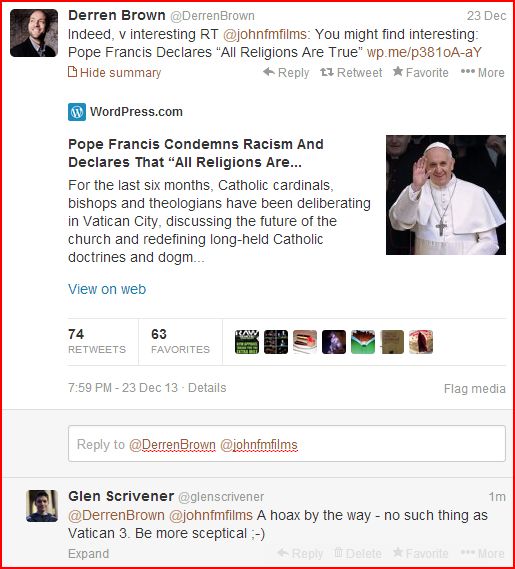
Conclusion: None of us are as rational as we like to imagine. We find ourselves able to justify any number of foolish beliefs if they line up with what we wish were true. Sometimes sceptics need to be more sceptical.
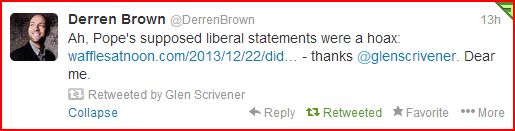
Update: Derren Brown tweeted a correction last night, good on him.
 If the God of the Bible exists then this God is the certain thing, we are the added thing, right?
"In the beginning" there was this God and we've come along later.
What's more, according to the Bible, this God: Father, Son and Holy Spirit, creates not out of need but out of generosity - not from emptiness but from fullness. Make sense?
If that's the case then we are entirely unnecessary, a profligate extravagance, a superfluous addendum, an embellishment, a flourish. We are not needed at all. We are wanted, which is nice, but it all puts us soundly in our place.
So that's the position if the God of the Bible actually exists. But... if such a God doesn't exist then, of course, we are the certain thing. The natural world (as Enlightenment people are wont to call it) is what's really real. The super-natural? Well that's, by definition, the extra thing isn't it? What we can see, hear, touch, taste and feel is rock solid. Anything beyond that is sinking sand, wouldn't you say?
Now... in a discussion between a Christian and an atheist, who has the burden of proof? Who must justify their position by bringing evidence that overwhelms the assumed 'default position' (the null hypothesis)?
If we were talking about the existence of Big Foot, we can probably all agree that those who believe in Big Foot's existence have the burden of proof. They need to bring convincing proofs or else we'll continue to hold our null hypothesis. Our null hypothesis is: Big Foot's existence is unproved and in serious doubt until further, convincing evidence is produced.
So then, why not say exactly the same about the Christian God? Why not say "The existence of God is in doubt until extraordinary evidence is produced"? Why not put the burden of proof on the Christians?
A couple of reasons off the top of my head:
1) God is not in any way like Big Foot. Big Foot (if he exists) is an extraordinary being within the created order. But God - despite how both atheists and some theists want to paint Him - is not just a super-being. The God of the Bible is the Source of Being. And the difference between a super-being and a source-of-being is not one of mere quantity. We're talking about a qualitative difference of infinite proportions.
According to Acts 17: "In Him we live and move and have our being." If Big Foot actually existed it would have no implications except for a small number of enthusiasts. God's existence changes everything for everyone. Who He is, fundamentally changes the universe we inhabit. It changes who we are - suddenly we are unnecessary-but-loved creatures of the living God. Therefore God's existence cannot be held at arm's length and discussed at a distance. When we talk about God we're talking about a reality-defining being. He defines us. And He also defines - must define - Himself.
That's the second reason why the burden of proof is not obviously with the Christian...
2) Anyone who claims that God must justify His existence is clearly not dealing with the Christian God. The great I AM is. Actually God must justify our existence! If that doesn't sound right it can only be because we're not considering the actual God of the Bible. To think of God as a potential addendum to reality is not to think of the living God.
If a person claims that God's existence is possible but requires additional proofs, they show that they are refusing to consider the reality of God. If the triune God exists then God is not the 'added thing' whose reality may or may not be granted. If the Christian God exists, we are the added thing. If the Christian God exists, He must be taken for granted as the certain reality or else we're just not talking about God, only a Big Foot in the Sky.
Who has the burden of proof? It all depends on whether God exists! If the triune God lives then of course it's our existence that must be justified, not His. The good news is that God the Son does justify our existence - He enters it, redeems it and binds it to His own existence forevermore. Jesus is not simply proof of God's existence - He's the guarantee that we exist - really and truly connected to the eternal life of Father, Son and Spirit.
But if the triune God of Scripture doesn't exist - if 'God' is merely a super-being somewhere or there is no god - then the burden of proof would lie with the theist. Because then our existence would be most fundamental and the extra thing - 'God' - would have to show itself.
So then, if someone insists that the burden of proof is with the believer, they may claim to be open-minded about the possibility of God but they have, in fact, decided the issue in advance. By setting things up in this way they have determined not to deal with the great I AM, only with a potential super-being (and only if that super-being passes the tests they set).
In other words:
No-one seeks God... Faith comes through hearing (Romans 3:10; 10:17)

Earlier today Derren Brown retweeted this photo with the comment "Oh Lord." It's had 85 retweets and counting. Here are some of the comments in replies:
The list is backwards
'You last'. What a heart-breaker
So sad, make them feel guilty, bad and no self worth...sorry no religious belief from me!
On the original Classic Pic tweet were the following comments (swearing coming...)
disgusting crap message on the wall. abandoned child must focus on invisible Jesus rather than own needs
that is the saddest thing I have seen in days. *sob*
fuck that, fuck the message on the wall
This is a desperately sad photo. Not just the message, but the stark walls and the bleak, loveless room.
Interesting photo. Revolting story told in the photo.
Everything that's wrong with religion
"Dear Lord. i thanks you for giving me no parents and a shitty start in life."
Torn between sorrow and rage.
This is all sorts of horrible. Poor kid.
Horrible, horrible child abuse. Disgusting.
I grew up with "Jesus, Others, Yourself" - JOY comes by putting yourself last, right? If you grew up in a Christian home I'd be surprised if you've never come across the acronym. I mention this so that no-one thinks this is the orphanage's way of putting the children in their place. This is not a power-play, it's the opposite. This is the essence of the way of Jesus: self-giving sacrifice as the way to fullness of life.
But what's fascinating to me is that in 1947 'Self Last' would have been roundly endorsed as the moral position. Today 'Self Last' is not just strange or inadvisable, it's immoral. It's disgusting crap. It's everything that's wrong with religion, etc, etc.
But what do we have in this photo? We see a little girl in need. She's an orphan and our hearts go out to her. But who is actually caring for her? Answer: the people who believe in "Self Last", that's who. And which body of people have had the longest and most impressive history of caring for orphans? Christians - i.e. those who believe in 'Self Last'.
What's the alternative? Shall we declare 'Self Last' as an abusive sentiment? Shall we endorse 'Me First' instead? How many orphanages could be built on that foundation?
But, some will say, this girl is at the bottom of the heap already. How crushing for her to be told to pray this hierarchy into her heart every day! Isn't that abusive?
Ah but, here's the thing. All Christians pray 'Self Last.' I'll bet the Queen herself was taught this acronym. Everyone is called to the selfless life of Jesus. Christ's kingdom inverts all our 'Me First' values. As Mary's Christmas song (the Magnificat) reminds us:
He has brought down rulers from their thrones
but has lifted up the humble.
He has filled the hungry with good things
but has sent the rich away empty. (Luke 1:52-53)
'Self Last' is a philosophy that humbles the highest and lifts up the poorest. In the kingdom of 'Self Last' it's the lowliest who are greatest. As this little girl prays, she is in touch with the Lord of the universe - the Lord who stoops, serves, suffers and dies.
Just practically speaking, her greatest hope is the 'Self Last' people. They are the ones who care for orphans. And spiritually and existentially speaking, her greatest hope is the Lord who put Himself last. In His kingdom she is the greatest:
46 An argument started among the disciples as to which of them would be the greatest. 47 Jesus, knowing their thoughts, took a little child and made him stand beside him. 48 Then he said to them, ‘Whoever welcomes this little child in my name welcomes me; and whoever welcomes me welcomes the one who sent me. For it is the one who is least among you all who is the greatest.’ (Luke 9:46-48)
Dai Woolridge and Andy Toovey are worthy winners of this year's Nativity Factor.
They won with the excellent, "Joseph"
And here's last year's epic: "Christmas Chord"
In this episode Andy and I talk to Dai and Andrew about the what, the why and the how of spoken word videos...
NB: The reason the first couple of minutes of the interview are spent talking about our video is because I didn't really think the interview had begun :) We were just chewing the fat. Consider the proper interview to begin at 7:29.
In our series on online witness we have interviewed
Graham Miller of London City Mission
Gavin Tyte - Beatboxing Pastor
Matt Rich from the evangelistic site Groundwire
In this episode we talk to Tim Chester from The Crowded House in Sheffield.
Tim is the author of numerous books on subjects ranging from church planting to mission and social action to the Trinity. He recently wrote "Will you be my Facebook Friend?" where he raises vital questions about our online presence.
Are we creating false images of ourselves online? Are we substituting online community for face to face fellowship? Are we spending too long on social media? Is our online engagement properly Christian?
Andy and I chat to Tim about evangelism in general and our online witness in particular.
 Recently I asked a room of students what they would like me to cover in some upcoming evangelism training. The first two responses were telling...
How can we mention Jesus without it being awkward?
How can you tell someone "I'm praying for you" without it sounding weird?
I love those two questions because they pretty much sum up the entirety of evangelism. If you're someone who mentions Jesus a lot, who prays for your friends and tells them you're praying for them, you are basically the Billy Graham of personal evangelism. Honestly, it doesn't get any better than that.
You mightn't have a clue what to think about current affairs, let alone how to bring Jesus into it. You may have no answer to "the problem of evil" (of course the person we should really worry about is the guy who 'solves' the problem of evil). It may never have occurred to you that the latest Box Office Hit echoes the gospel in its redemptive plotline. But if you awkwardly but repeatedly mention Jesus, and if you pray for your friends and - weirdo alert! - tell people you're praying for them - you are my evangelism hero and I want to be just like you.
The only thing I'd add to this odd-ball strategy would be - cringe factor!! - invite folks to church. Not necessarily the polished evangelistic event. I just mean church with all its embarrassments which you, as a family member, are very aware of. At that point, it's pretty much job done: mention Jesus, pray for your friends, invite them to church. There's my evangelism training in a nut-shell.
Now, if you want to do those things and not feel awkward... me too. But I'm not sure there's training in the world that can disarm the jarring power of the name of Jesus. And if there is, you should avoid it like the plague.
Evangelism means identifying with Christ in the world of Adam. No training can prevent a mortifying clash. But... if you embrace the mortification you'll be a better evangelist than all the training in the world can make you!
Andy and I are in a series discussing online evangelism. Last week we spoke to Gavin Tyte about just living out our passions authentically and allowing our love for Jesus to naturally flow. This week we think about more intentional online witness.
Matt Rich runs a chat helpline website called Groundwire that connects with hundreds of people a month, answering questions about the Christian faith, and pointing people to Jesus through their local church.
I think Groundwire is a fascinating example of how pastoral care and evangelism coincide. If you ask me evangelism is pastoral care and pastoral care is evangelism. Our churches and our mission will be a lot healthier when we make those links.

In 2011, Gavin Tyte won ITV’s Nativity Factor with his Beatbox Nativity (see below).
Gavin is an ordained Anglican minister and now a full-time pastor to the beatboxing community. In this interview, Gavin talks about his faith, his beatboxing and his witness. He speaks with refreshing clarity about the need to be authentic - to love people, to use our gifts and to let our witness flow out of a genuine love for Christ, for people and for the world.
Check out Beatbox Bible to see Luke's Gospel rapped and to learn to do the same - what a resource!
Andy and I really enjoyed talking to him, hope you enjoy listening.
Last week we spoke to Graham Miller from London City Mission about the work of LCM.
This week we pick his brains on online evangelism. Here is just some of the wisdom he shares...
Sometimes evangelistic sites can be hijacked by atheists trying to wind up the Christian apologist, perhaps we need more "walled gardens" in internet evangelism - e.g. Facebook groups that discuss deeper issues, news stories. It's a short walk from a serious conversation to a gospel conversation.
The internet enables the resourcing of evangelists much more broadly as expertise is shared.
People in the UK are very private people, even if Christians are being loving, it's not on show. But the internet is an opportunity to open the doors on that.
Do we just vent our spleen online? Or do we realise that online is one more dimension of our Christian discipleship?
Remember that our disagreements online are public.
Churches are the best apologetic - the best witness. The love of a church community together is the ideal. But the internet is part of the picture - it can be a step on the way to church community.