Skip to content

big-fish-eat-little-ones


Storms are bigger than we are.

Jesus is much bigger still.

We're small.

We're passive.

We're at the mercy of bigger forces.

Either Jesus steps in or we're doomed.

When He does step in it's even scarier!

Jesus is just as unmanagable as the storm

The difference is Jesus loves you, the storm doesn't.

Jesus is the Ultimate Jonah hurled into the Ultimate Storm to bring us peace.

That's why we can trust Him.

So, Who or what will we fear?

Who or what will we trust?

And Who is this Jesus?

He's the One who sails with us in the storm,

Yet He rules over the storm by His mighty word

And in the storm - that's where we really come to know Him.

.

Those are the sort of thoughts informing this sermon on Mark 4:35-41 - Jesus calms the storm

Audio mp3 file here

.

Eating with Jesus.  What a privilege!  And what danger!  There need to be warnings.

.

.

I preached this sermon at a service of Holy Communion in another church. 

It was essentially an extended warning to all would-be communicants: If you eat with Jesus you are confessing to Him and the world that you are a sinner.  Jesus eats with sinners.  Only with sinners - He has not come for the righteous.  The righteous must go hungry. Only the needy, the sick, the outsiders, the unclean, the powerless, the guilty will find Bread.  You are qualified by your unworthiness.  Entirely unfit and therefore welcome. 

So come.  And let your coming be your contrition, let it be your confession, let it be your repentance and your faith.  Come and eat with Jesus.

.

It's the kind of sermon I want to be preaching until I die.  Listen here - the text is Mark 1:40-2:17.

.

1

.

Do you believe these words from Jesus:

Others, like seed sown on good soil, hear the word, welcome it, and produce a crop--thirty, sixty or even a hundred times what was sown.  (Mark 4:20)

Christ's promise for Christian fruitfulness is out of this world.  3000%, 6000% or 10 000% is an incredible yield.

Do I dare believe in this kind of growth?  To put it another way, Will I hear and welcome this word?

We would believe Jesus if He said "five times what was sown!"  We marvel at 300% yield.  We settle for two-fold growth.  But Jesus promises something so supernaturally grand we must ask, If I believed Jesus' words about Jesus' words how would I treat Jesus' words? 

Well Mark 4:20 means I'd hear them and welcome them. 

Mark 4:10-12 means I'd hear them with Jesus at the centre - allowing them to draw me to Him.

Mark 4:15 means I'll hear them prayerfully, recognizing the spiritual battle undertaken every time they're heard.

Mark 4:16-17 means I'll cling to them when trouble comes - allowing the trouble to drive me deeper into Christ in His word.

and

Mark 4:18 means I'll be vigilant against wealth, worry and wanting as powers competing in my heart for attention.

But Jesus promises -- PROMISES -- that hearing and welcoming His word in this way will produce a transformation in our lives beyond belief.

How will the word produce transformation?  The way a seed produces growth.

.

It will be:

Weak Looking but Powerful

.

Internal but Outgoing

.

Gradual but Multiplying

 .

.

First, Weak Looking but Powerful

Tim Keller tells the story of a man from the middle ages who was so terrified of meeting Jesus at the judgement that he commanded a giant marble slab to be put over his grave.  Apparently he did this so that, when everyone else was resurrected, he would stay down.  Well before the burial was complete and the slab was laid, an acorn fell into the grave. Over the years, a great tree grew, split the slab in two and moved it off the grave.

You might have thought, What chance does a little acorn have against a giant marble slab?  No contest, the acorn wins.  It looks so weak but it is more powerful than a team of horses.  Weak but powerful. 

Just like the Word.  You say a few words about Jesus, you speak truth into another person's life and it looks pathetic.  And yet eternities are changed and lives are transformed. 

Second, Internal but Outgoing

Last week a friend of mine told me of the worst pain he'd ever felt in his life.  In the midst of it the words came to him: "My grace is sufficient for you for my power is made perfect in weakness." (2 Cor 12:9)  It enabled him to handle that pain with an astonishing peace.  Where did that word come from?  It had been planted there.  And it grew up later with an amazing power to comfort.  The word goes in and it comes out organically.  

This is not the parable of the Brick Supplier who drops off masonry to four different builders.  That would be a story about externals and effort and easily measurable growth.  But no, the word goes in like a seed and later, organically, it comes out.

Third, Gradual but Muliplying

Think of this: within a single acorn lies all the genetic information required to produce not only an oak, but from that oak will come scores of new acorns.  And from them more trees with hundreds of acorns and so on.  Given enough time a single acorn could cover the whole earth in wood.

Luther knew this gradual but multiplying power.  When explaining how he opposed the whole Roman church he said this:

I simply taught, preached, and wrote God's Word; otherwise I did nothing. And while I slept or drank Wittenberg beer with my friends Philip and Amsdorf, the Word so greatly weakened the papacy that no prince or emperor ever inflicted such losses upon it. I did nothing; the Word did everything.

 That's the power of the word. 

So do we believe Jesus when He says, Thirty, Sixty, a Hundred-fold?

.

This is from a sermon I preached on Mark 4:1-34:

Listen here

Read here

.


Titus 1:9 in my amplified translation:

[An elder must be] Continuing to hold fast / grasp / embrace / protect the word of faith according to The Teaching, so that he is able, on the one hand, to encourage in healthy teaching and, on the other, to prove to opponents their error.

The word for 'holding fast' is elsewhere translated "grasp" (Dt 32:41); "embrace" (Prv 3:18) "protect" (Prov 4:6); "hold fast" (Is 56:2,4,6); "make refuge in" (Is 57:13); "be devoted to" (Matt 6:24). 

Interestingly enough the teaching which we are to embrace is (Rom 6:17) the teaching which embraces us.  We hold fast this gospel and at the same time it is this gospel over to which we have been handed.

The Christian's (especially the Christian teacher's) relationship to the gospel is portrayed in almost marriage terms of mutual cleaving.  We serve, honour and protect it - and it serves, honours and protects us!

But why?  My almer mater's motto was "Be right and persist."  Not the warmest, fuzziest motto you've ever heard!  And even if you agree with the sentiment, why be right?  For the sake of doctrinal precision itself? 

Titus 1:9 continues... To what end do we 'cleave' to the apostolic gospel?  So that

1) we can encourage with healthy teaching and

2) we can prove the error of those who would corrupt it.

William Taylor, speaking on this verse, gave a striking illustration of both the gospel's health-giving quality and the need to guard against all corruptions.  I have adapted it a little:

Imagine you get a job as a courier for a pharmaceuticals company.  And one day you are called to the lab to pick up a very special delivery.  You arrive at the lab and you are told ‘We have discovered the cure for AIDS.  Here it is in this vial. We want you to take this immediately to Africa so they can duplicate it and save the lives of millions.'  Well you take hold of this fragile vial which is covered in yellow tape saying ‘Do not open' and ‘Do not break the seals.'  And you get on the next flight to Johannesburg. 

But imagine sitting on the plane and thinking: this cure doesn't look very promising.  I'm not sure it'll be attractive to the folk in Africa.  So you think ‘I'll spruce it up a bit.'  You tear off the yellow tape, break the seals, open the vial and decide to pour in the rest of your drink.  You stir your Coke in and put some sweetener in for good measure.  Shake it up, lose a bit.  Doesn't matter, you've made the whole thing much more tasty.

As you arrive in Johannesburg you're met by a scientist desperate for this cure.  She sees that the seals have been broken and her face falls.  You've turned the health-giving cure into a toxic poison- and lives are lost.

That scenario is just unthinkable isn't it?  And yet many people entrusted with passing on the gospel tamper with it in just this kind of way.  They add or they subtract or they sweeten according to their own tastes.  They feel it is their job to concoct their own elixir, rather than pass on the bona fide cure.  But no!  It is the job of the elder NOT to mess with the bible's teaching.  It is the job of the bible teacher to simply embrace it, rejoice in it, protect it, and deliver it unadulterated.  The bible teacher must be absolutely and utterly unoriginal.  We must treat the good news about Jesus like the health-giving cure for AIDS - embrace it, rejoice in it, protect it, and never, ever change it!  And if you see anyone else changing it you say ‘In the Name of Jesus Christ stop.  Return to the original, life-giving message!'  Because the gospel saves people from a fate far worse than AIDS.

.

This is adapted from a sermon on Titus 1:5-9 I preached yesterday. 

Audio file hereRead it here.

.

Here's a talk I did in the middle of a pub quiz (audio here).  I posted up the script in advance here.  In the end I modified it a bit.  Essentially the original talk boiled down to 'Go and live for Christ!'  The changes I made were basically to say 'See how He lived and died for you... Now don't you want to live for Him.'  An improvement I think!

Here's a talk I did on John 4 (audio here).  If I'd known about it, I'd have definitely included this quote from Malcolm Muggeridge (thanks Marc)   

I may, I suppose, regard myself, or pass for being, a relatively successful man. People occasionally stare at me in the streets-that's fame. I can fairly easily earn enough to qualify for admission to the higher slopes of the Inland Revenue-that's success. Furnished with money and a little fame even the elderly, if they care to, may partake of trendy diversions-that's pleasure. It might happen once in a while that something I said or wrote was sufficiently heeded for me to persuade myself that it represented a serious impact on our time-that's fulfilment. Yet I say to you, and I beg you to believe me, multiply these tiny triumphs by a million, add them all together, and they are nothing-less than nothing, a positive impediment-measured against one draught of that living water Christ offers to the spiritually thirsty, irrespective of who or what they are. What, I ask myself, does life hold, what is there in the works of time, in the past, now and to come, which could possibly be put in the balance against the refreshment of drinking that water?

Sermon delivered at Queen's Cross Church, Aberdeen, 26th May 1968, reprinted in Jesus Rediscovered (Garden City NY, Doubleday, 1969) pp76-82 and also in Seeing Through the Eye: Malcolm Muggeridge on Faith edited by Cecil Kuhne (Ignatius, 2005) 'Living Water' p97

.

I preached on Romans 3:21-26 recently.  It's a dense, theologically loaded paragraph on the vindication of God's justice in justifying the unjust through the cross.  Leon Morris has called it perhaps the most important paragraph ever written.

So how to preach it? Well it's Paul, so then clearly a strong didactic form is called for.  Verse by verse, commentary in one hand, a greek lexicon in the other.  Unpack the massive theological freight piece by piece and if you're lucky some doxology tacked on the end (if you're unlucky, an exhortation to evangelism).

Well, perhaps you'll think that's more the model I ended up with.  But close to my heart throughout the preparation was this desire simply to meditate on the three scenes Paul gives us. The law court (v19-24a); the slave market (v24b) and the temple (v25). 

To be honest, if I'd had my time over I think I would have ditched everything else and just gone with a simple meditation.  I'd have gotten the congregation to close their eyes and come with me on a journey...

You are in court. Standing in the dock. You and all humanity. The arms dealer is to your left and the amnesty international human rights lawyer is to your right. In front of you is a paedophile, behind you is Mother Teresa. But there you are in the dock.  The court room intimidates you, everything in it is against you.  You know that your very life hangs in the balance. You dread the verdict that is about to be announced.

The judge reads out these words. As he reads, you know that every charge is unquestionably true:

You are not righteous.

You have no understanding.

You do not seek for God.

You have turned away.

You are worthless.

You do no good.

Your throat is an open grave.

You use your tongue only to deceive.

The venom of vipers is under your lips.

Your mouth is full of curses and bitterness.

Your feet are swift to shed blood

Ruin and misery mark your way.

You have not known the way of peace.

There is no fear of God before your eyes.

The whole court-room is silent but the words ‘not righteous', ‘no understanding' and ‘worthless' still ring in your ears. Your mouth is stopped. You cannot answer a single charge. It's all true and the weight of condemnation is crushing.

The judge raises his gavel. There can be only one verdict. The hammer crashes down. The judge declares it:

I find you not guilty.

The court-room changes in an instant. Smiles everywhere. The judge steps down off the bench to congratulate you.  You are lost for words.

"How?  Why?  What...? 

Large doors are opened and great light comes in. The guards usher you through the doors and out into the light.

The scene has changed.

You find yourself in a first-century market-place. You are hungry. You have no shoes. Instead you stand in iron shackles - owned by a cruel master.  You have never known any different.  You stand in front of the mob and the bidding starts for you.  The price goes up and up and you dread the reasons why anyone would pay so much. 

"Sold!" you hear.  And you peer into the crowd to find out who.  Suddenly a man emerges.  He smiles, bends down and unlocks your shackles.  He stands up, looks you in the eye and says "You're mine now."  You reach for words but they don't really come...  "Why?  How?  What did you pay?"

"Let me show you" He says and takes you by the hand out of the market.

Immediately the scene changes again. You are at the temple, standing - like all the other sinners - in the queue for the altar.  You are carrying a young lamb in your arms just like the law tells you.  At the front of the queue someone lays their hand on the head of their lamb, confessing their sin.  Then, holding its wriggling form down on the altar, they slit its throat - the blood gushes out.  You see the blood and you know that's what you deserve as a sinner.  You shuffle forwards towards the altar.

Suddenly, from deep within the temple a voice booms out ‘Stop the sacrifices.' You drop your lamb in fright, as does everyone else.  They all scurry away. Then you see the most shocking sight of your life.  The LORD God Almghty emerges from within the innnermost sanctuary.  You are stunned.  But not half as stunned as you are about to be.  In His strength the LORD strides towards the altar. He lays down on it, and carrying the sins of all the people the LORD is slain and His blood is spilt.

And now you know - the verdict you didn't deserve, the freedom you didn't earn - it was purchased by the blood of the LORD Jesus Himself.  You look to the altar to see your God now become your Lamb and His blood now become your atonement.  Shaking your head in wonder you leave the temple, the weight of your sin gone - the weight of His glory upon you. 

Go back to the dock.  Remember your guilt.  Now feel the wonder of the verdict.

Go back to the slave-market.  Remember your bondage.  Now feel the joy of your freedom.

Go back to the temple.  Remember the queue for the altar and whose blood was really required.  Now feel the awe as you behold the Lamb of God bleeding for your sins.

.

I should have just preached that don't you think?

Anyway - I went for a bit of a compromise.  Didactic with a touch of meditation thrown in.

Read it here

Listen here.

.
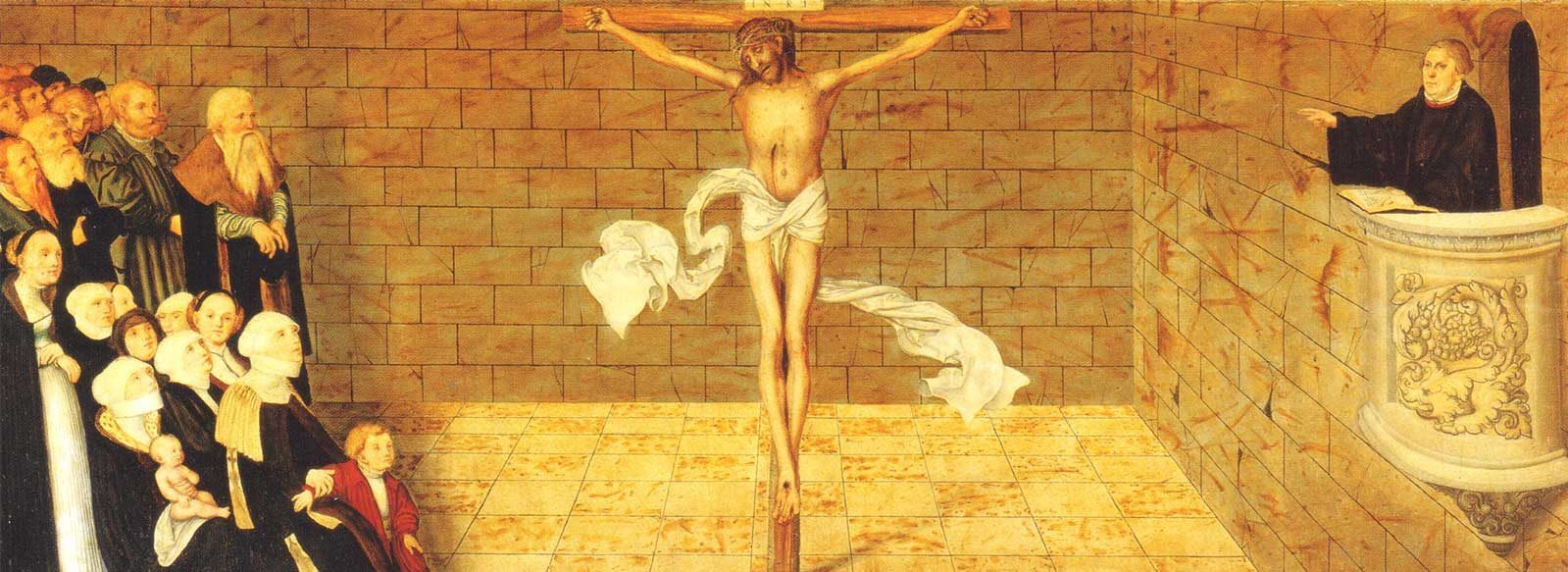
From a Tim Keller sermon on 'the first shall be last':

There was once a young seminary graduate eager to preach his first sermon.  He ascended the pulpit steps, sure his great learning would amaze the simple lay folk.  Halfway through the sermon he realized he was making a hash of it.  First the congregation lost what he was saying, then he lost what he was saying.  At the end he climbed down from the pulpit crestfallen.  An old Christian woman met him at the end and said "If you'd have gone up the way you came down, you'd have come down the way you went up."

.

3

From a Tim Keller sermon on 'the first shall be last':

There was once a young seminary graduate eager to preach his first sermon.  He ascended the pulpit steps, sure his great learning would amaze the simple lay folk.  Halfway through the sermon he realized he was making a hash of it.  First the congregation lost what he was saying, then he lost what he was saying.  At the end he climbed down from the pulpit crestfallen.  An old Christian woman met him at the end and said "If you'd have gone up the way you came down, you'd have come down the way you went up."

.

Some thoughts generated from a sermon on Mark 2:18-3:6

.

In Mark 1:40-2:17 we saw three stories about the people of Jesus' kingdom.  And this was the shock: The people of Jesus' kingdom are the lepers, the paralytics, the tax collectors and their spiritual equivalents.  Jesus calls sinners.  Sinners.  Not the righteous.  Jesus' people are not the people religion expects. 

In Mark 2:18-3:6 we continue with this revolution.  In these three stories the focus is on practices - in particular fasting and Sabbath observance.  And again, Jesus' practices are not the practices religion expects.

Jesus does not fit our religious moulds.  And so over the top of the three stories stands Mark 2:21-22 where Jesus gives us this mental image:

"No-one sews a patch of unshrunk cloth on an old garment. If he does, the new piece will pull away from the old, making the tear worse. And no-one pours new wine into old wineskins. If he does, the wine will burst the skins, and both the wine and the wineskins will be ruined. No, he pours new wine into new wineskins."

People are looking at Jesus and struggling to fit Him into their way of thinking.  But Jesus is saying:  It's not that I don't fit into your religious expectations.  Jesus says I won't fit into your religious expectations.  It's impossible to contain Jesus within moulds that aren't already designed with Him at the centre.

Jesus and His practices are like new cloth and if you try to patch them onto any old cloth it will tear apart the garment.  Jesus and His practices are like new wine and if you try to contain them within any old wineskin it'll burst the thing apart.  Whatever spiritual forms that exist in Jesus' kingdom they must consciously and explicitly be oriented to Jesus Himself.  Christ refuses to be just one more ingredient in a human religion.  You can't just take a bit of this spirituality and a bit of that philosophy and add a twist of Jesus.  You can't take your own common sense, your own culture's moral code and then expect Jesus to fit in.  Jesus demands a complete revolution.  If we haven't already, we have to begin afresh with Jesus.

In Jesus' kingdom, if you fast, you fast because of Him (you experience the absence of your Bridegroom - the true meaning of the Yom Kippur fast).  If you feast, you feast because of Him (you anticipate the presence of your Bridegroom).  If you observe Sabbath you do so 'to the Lord'.  If you don't, that's also 'to the Lord' (Rom 14:5-9).  Whatever forms of spiritual practice that exist in Jesus' kingdom are to explicitly relate to the Person of Christ.

Now apply this to any spiritual practice.  The question is not whether nor is it which practices you perform, not in the first instance.  The most pressing question is why.  More specifically the question is how is Jesus Himself the centre of this practice?  Think, for instance of bible reading.  Is reading the bible a spiritual practice of yours?  Why?  Because that's what Christians do?  Because advancing the bookmark makes you more holy?  Well you've just stripped Jesus out of this spiritual practice and turned it into human religion. 

Jesus spoke to the religious of his day who clung onto the scriptures as an old wineskin, yet they had no place for Jesus:

You diligently study the Scriptures because you think that by them you possess eternal life. These are the Scriptures that testify about me, yet you refuse to come to me to have life.  (John 5:39-40)

This is simply an extension of the wineskin principle to the Scriptures.  Without Jesus consciously at the centre of this practice it becomes an old wineskin - unable to cope with the reality of Jesus Himself.

Now of course the Scriptures, viewed truly, already have Jesus at the centre.  In the same way fasting and Sabbath, viewed truly, always ought to have had Jesus at the centre (hence Jesus' consistent appeals to the Old Testament in Mark).  But it's entirely possible that proper looking religious practices - even biblically mandated ones - can miss the whole Point.  The danger is always that we hold onto spiritual forms and neglect our spiritual Centre.

What spiritual practices do we need to re-examine in this light?

.

Read the sermon here

Listen here

.

Adapted from a sermon on Mark 1:40-2:17

.

Jesus' teaching.  Jesus' followers.  Do you ever have trouble putting those two things together?

In a sense that's the problem the Christian faces as they seek to follow Him.  And it's the problem the non-Christian has as they look on.  How do Jesus' teaching and His followers go together??

Think about it.  With Jesus we hear righteous teaching like the world has never heard.  And yet, who flocks to Him?  The scum, the low-lives, the outsiders, the sinners.

Jesus teaches the hardest line on good living ever imagined.  He even says at one point "Be perfect as your Heavenly Father is perfect." (Matt 5:48).  Jesus raises the spiritual temperature to nuclear - and who flocks to Him?  Not the priests?  Not the religious types.  Not the goody goodies.  Those guys, in their long flowing robes are standing on the edges of the crowd, arms folded, plotting to destroy Jesus (Mark 3:6). 

The LORD Almighty walks around 1st century Palestine.  The Son of the Living God is calling His people and who is His entourage?  Unrighteous, disreputable outcasts.  It's a tremendous shock but it's at the heart of what Jesus came to do. 

As He says in Mark 2:17 "I have not come to call the righteous, but sinners."  Jesus is the abolition of religion.  All human religion says "God calls the goodies not the baddies."  Jesus says "I call the baddies not the goodies."  Jesus is the abolition of religion.

The religious types stand on the fringes plotting to do away with Jesus.  But Jesus is at the centre doing away with religion.  These verses (Mark 1:40 right up until 3:6) are a fight to the death between Jesus and religion.  Religion is working to kill Jesus but Jesus is working to kill religion.

.

To read the whole sermon go here

To listen go here

.

Twitter widget by Rimon Habib - BuddyPress Expert Developer