Skip to content

The great majority of my preaching has been lectio continua - that is, preaching through books: chapter by chapter, verse by verse.  The sort of churches I've attended and worked in have always preached in this way.  And I see a thousand benefits to it.

But, just thinking aloud here... I wonder what would happen if a law was passed banning lectio continua.  What if we just weren't allowed to fill our preaching programmes with Exodus 1-20 then Philippians then Matthew 11-15 then some Advent sermons then back to Exodus...

What if preachers had to feed their congregations Sunday by Sunday with the nourishment the Lord's been providing for them personally?

Now obviously the Lord might be thrilling our hearts with the next chapter of our assigned reading.  And so often I've had the experience of finding a 'new favouite chapter' of the bible as I've studied the passage for that Sunday.

But still.   And granting that hobby-horse-preaching can also mask spiritual morbidity, I just wonder...

If lectio continua was banned, might it not show a thousand preachers to be empty, barren and dry as dust?

Just asking

.

12

Romans 5:12-21


Look at yourself in Adam; though you had done nothing you were declared a sinner. Look at yourself in Christ; and see that, though you have done nothing, you are declared to be righteous. That is the parallel. We must get rid of all thoughts of our actions there is no boasting. We do nothing; all we are and have results from the obedience of the One – our Lord.” –Martyn Lloyd-Jones preaching on Romans 5:18,19, taken from: Romans 5: Assurance, p274.

Sermon audio here (sorry, my sermon not the Doctor's!)

Text below...

...continue reading "Grace Alone – sermon"

I always think of what to say about 2 hours too late...

I was briefly discussing sola Scriptura ("Scripture alone") with a mate and mentioned (among other verses) 1 Corinthians 4: "Do not go beyond what is written."

He said "Apparently that was a common saying of the Pharisees in their day."

My response at the time was "I didn't know that."  Which had the one saving grace of being true.

Two hours later, with brilliant (retrospective) timing, I delivered my wry riposte into the echoing chambers of my mind: "Wait... How do we know that?"

Because, if you accept such an interpretive context, you either say:

'Don't go beyond what is written' is best understood by going beyond what is written.

Or - if you're really committed to the cause - you'll say:

"Ha! Even extra-biblical sources support sola Scriptura!"

I really like the latter.  It's a defence of irrefutable illogicality and impregnable stupidity.

Just my style.

.

.

.

.

I've posted quite a few long-winded reflections on faith in the past.  (And how we shouldn't reflect too much on it!)  Here, here, here and here.

But they're all summed up and vastly surpassed by one paragraph of John Stott's Romans commentary:

"Further it is vital to affirm that there is nothing meritorious about faith, and that, when we say that salvation is ‘by faith, not by works', we are not substituting one kind of merit (‘faith') for another (‘works').  Nor is salvation a sort of cooperative enterprise between God and us, in which he contributes the cross and we contribute faith.  No, grace is non-contributory, and faith is the opposite of self-regarding.  The value of faith is not to be found in itself, but entirely and exclusively in its object, namely Jesus Christ and him crucified.  To say ‘justification by faith alone' is another way of saying ‘justification by Christ alone'.  Faith is the eye that looks to him, the hand that receives his free gift, the mouth that drinks the living water. ‘Faith... apprehending nothing else but that precious jewel Christ Jesus.' (Luther's Galatians).  As Richard Hooker, the late sixteenth-century Anglican divine, wrote: ‘God justifies the believer - not because of the worthiness of his belief, but because of His worthiness Who is believed.'  (John Stott, The Message of Romans, IVP, 1994, p117-118).

Isn't that brilliant?

He goes on a bit later...

"...The antithesis between grace and law, mercy and merit, faith and works, God's salvation and self-salvation, is absolute.  No compromising mishmash is possible.  We are obliged to choose.  Emil Brunner illustrated it vividly in terms of the difference between ‘ascent' and ‘descent'.  The really ‘decisive question', he wrote, 'is the direction of movement'.  Non-Christian systems think of ‘the self-movement of man' towards God.  Luther called speculation ‘climbing up to the majesty on high'.  Similarly, mysticism imagines that the human spirit can ‘soar aloft towards God'.  So does moralism.  So does philosophy.  Very similar is the ‘self-confident optimism of all non-Christian religions'.  None of these has seen or felt the gulf which yawns between the holy God and sinful, guilty human beings.  Only when we have glimpsed this do we grasp the necessity of what the gospel proclaims, namely ‘the self movement of God', his free initiative of grace, his ‘descent', his amazing ‘act of condescension'.  To stand on the rim of the abyss, to despair utterly of ever crossing over, this is the indispensible ‘antechamber of faith'."  (John Stott, The Message of Romans, IVP, 1994, p118.  Brunner quotes from The Mediator)

.

In the debates on justification - don't ever lose those two paragraphs!!

.
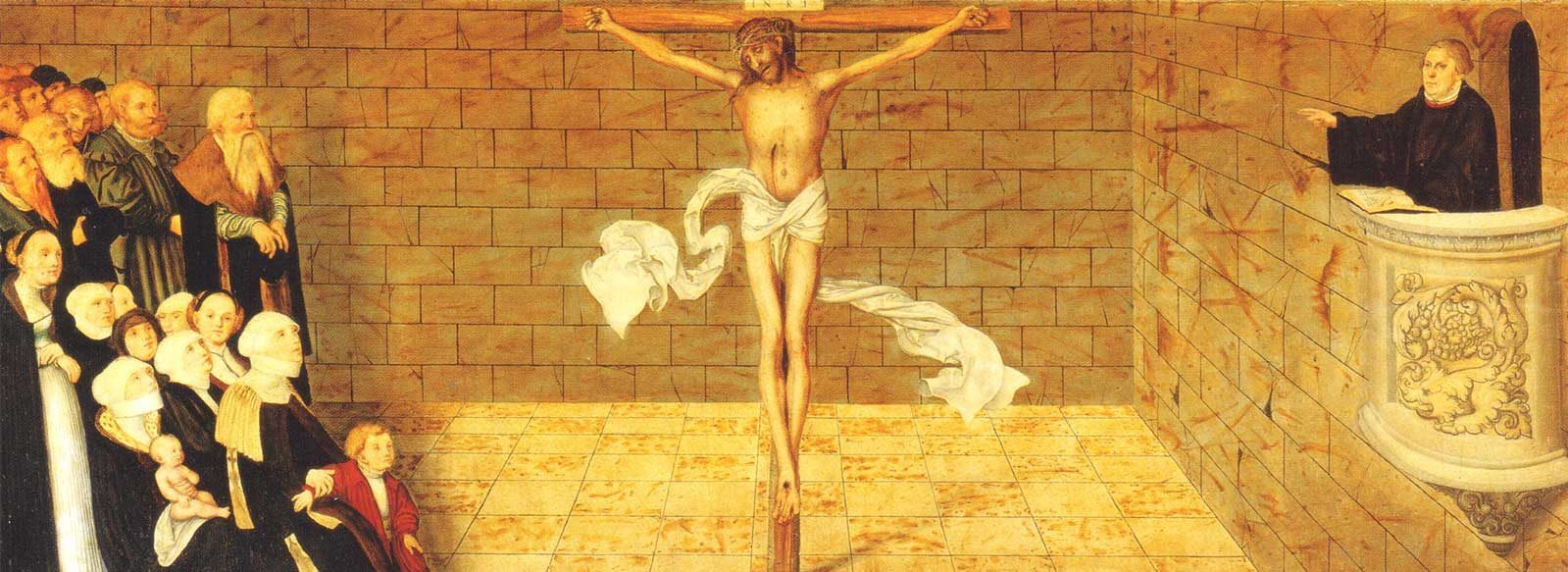
On Sunday I began our Gospel Alone series with this sermon on Christ Alone.

Audio here.  Excerpt beneath.  Full sermon at the end.

We do not know God except in Christ alone.  We are not saved by God except in Christ alone.

Does that sound narrow?

It’s only as narrow as Christ is.  So how narrow is Christ?

He is the Eternal Image of the otherwise Invisible God, the Creator and Redeemer of the Cosmos in Whom the fullness of deity dwells.  How narrow is He?  He is vast, He is beyond imagining.  He fills the universe and the fullness of God fills Him.

We don’t say “Christ alone” to be narrow.  We say 'Christ alone' because there’s no room for anyone else!  He is the eternal Son of the Father, our Maker and our Saviour, Who reconciles the cosmos back to His Father – there’s just no room for anyone or anything else.  That’s why we say 'Christ alone'.

It’s not about being narrow.  It’s just about naming the true Lord of this world.  The true Lord of this world is not Buddha or Allah or Krishna, He’s Jesus.  The true Lord of this world is not money, sex or power, He’s Jesus.  The true Lord of this world is not a big bang or a tiny particle or a long equation, He’s Jesus.

This is not narrow, this is simply naming the vast majesty of His Person and work.  It’s Christ alone, because when you understand who He is, there’s no room for anyone else.

And when you grasp the all-sufficiency of His Person and work - it transforms your view of Christ, of His Father, of the world, of salvation, of yourself.  To know Christ for Who He is means being drawn into His very life and work - to be caught up into the heart of all things.  Grasping 'Christ alone' changes everything...

Full sermon text below...

...continue reading "Christ Alone – sermon"

Twitter widget by Rimon Habib - BuddyPress Expert Developer