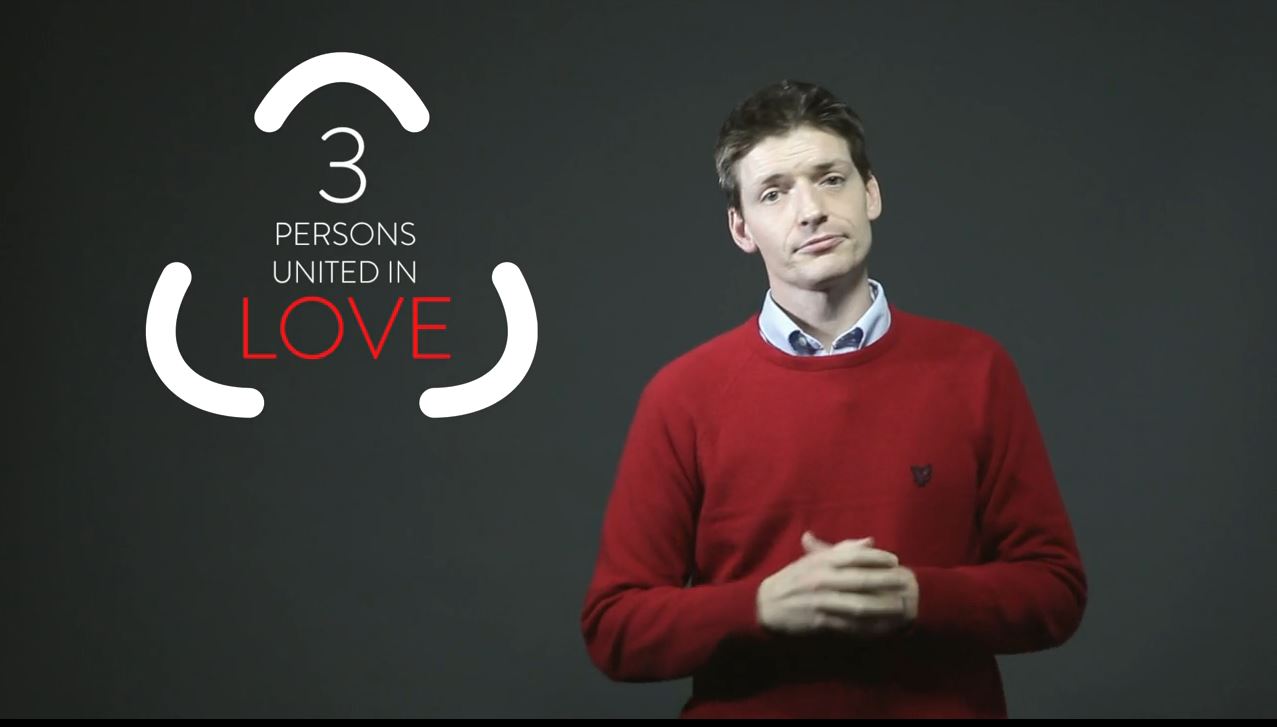
In our latest podcast we talk about Adam. Doesn't he complicate evangelism? Why discuss him?
The first thing to say is that 321 is not meant to be an inductive argument. It's not about getting agreement from people about the basics and working towards Jesus. It's simply about inviting the non-Christian into the Christian story and asking them to look around it from the inside.
I certainly do not expect agreement at the outset (otherwise I wouldn't begin with THREE!) What I want to do is paint a picture and ask the non-Christian to suspend disbelief for a few minutes while I explain the gospel.
Once I've explained the logic of Adam and Christ (perhaps from 1 Corinthians 15:21-22), then I can say something along the lines of...
"Do you understand the logic of the story - i.e. that Adam fell but Christ rose? If you get the logic then, sure, I completely understand your problem with Adam. But let's talk about Christ because, as you can see, the two are linked. I know you don't believe it, but the central Christian claim is that Christ rose. Let's examine whether Christ rose or not (from 1 Corinthians 15). If He rose, then Adam fell."
I am well aware that Adam is not a great stepping stone to Christ :) But then, nothing is a good stepping stone to Christ. Christ makes the bridge Himself.
Once again... we begin with THREE (and with creation and Adam) not because we're seeking to get agreement from the outset. We begin here because that's where the Christian story begins. And we beg the non-Christian's indulgence to let us finish the story.
If the non-Christian wants verification of the story's truth - we point to Christ and His resurrection from the dead. If Christ rose, the story is true (and Adam fell). If He didn't rise then the story is just a fairytale and we can forget it all.
In all this I'm saying "Don't get too hung up on the Adam question. Adam does not vindicate the story, the story vindicates Adam". But as we discuss these things, I find that non-Christians really get the emotional impact of Adam. Seeing humanity as a family, seeing how the whole family tree has been corrupted from the outset, seeing the disconnected state we're all naturally in, this all makes a heck of a lot of emotional sense. The wonder of Christ entering in to this mess to address our problems from the inside. That's a wonderfully attractive proposition. Play on that. And then let Jesus vindicate Adam (not the other way around.)
I speak more extensively about Adam and evangelism here and here.
In the previous episode we discussed THREE (Trinity). That's the first truth of 321. In this podcast we talk about TWO (Adam and Christ).
Here we'll discuss whether Adam complicates or clarifies our evangelism.
Surely - you might think - Adam introduces more problems than he solves. Well, down through the centuries, the church has stood solidly on the ground of Adam's historical existence. And we have stood on the doctrine of original sin. Why? Because the gospel falls apart without these truths.
So how do we speak of them without being led down a thousand conversational cul-de-sacs?
Last week Emma and I spoke at a mission weekend for Christ Church, Fetcham. Emma's talk on the Saturday night was wonderful, then on Sunday I preached on Who is Jesus (Matthew 3) and How to get free without getting lost (Luke 15). In the morning sermon I asked people to receive Jesus and, if they did, to grab me afterwards so I could give them a book and a word of encouragement.
At the end of the service everyone moved out to coffee and I stayed behind, follow-up books in hand. I guess I looked a bit exposed, just waiting. I certainly felt exposed.
After not too long the pastor of the church came over and stood with me saying "You look a bit lonely there, let me keep you company for a bit." A perfectly natural response. We don't like to see vulnerability and we certainly don't like feeling vulnerability. But actually, there's something inherent in evangelism that means exposure and weakness. When we avoid it we can find ourselves avoiding the very essence of evangelism: offering Christ.
Like seeds - tiny, pathetic looking, seemingly ineffectual - the word goes out and it appears like an exercise in futility. What good could be done by foolish words about a foolish-looking Lord? An arms-wide Saviour is, by definition, vulnerable - and the word of the cross shares in that vulnerability. No wonder Paul was fearful and trembling as he went about his preaching (1 Corinthians 2:1-5). Actually evangelism should be a vulnerable activity.
But it occurs to me that much of evangelism can be an attempt to cover over that exposure. We try to cover it with intellectual credibility (Clever people are Christians, it's the clever option). We try to cover it with cool (Cool people are Christians, it's the cool option). We try to cover it with processes (I won't ask you simply to receive Jesus, I'll ask you into a programme where conversion can be broken down step-by-step).
And I wonder how much of what we do is A) a refusal to share the vulnerability of our arms-wide Saviour and B) unbelief in the power of this weak-looking gospel to save people. Perhaps that's why we hope that The Next Evangelistic Resource will be the break-through the church needs. Or why we mistakenly believe that 'the evangelist' - with all their fool-proof methods and giftings - will solve all our missionary ills. Or why we can preach without invitation or offer. Or why, in everyday life we fail to speak up for Jesus when the opportunities arise. We don't want to appear as foolish as our crucified Lord. And we don't actually believe in the power of this foolish-sounding message.
Or at least I don't. And I need to repent of such thinking constantly.
By the way, after the service I stuck around much longer than I was comfortable with. But someone did come up to say he had trusted Christ. God had been speaking to him powerfully through the weekend. Please pray for him as he takes his first steps.
When 10 of those asked me to do an evangelistic video for Halloween, I knew the dangers. Immediately I predicted a range of reactions reflecting the range of views on the subject.
When John Piper was asked about Halloween he summarized these varying approaches...
How to write something that satisfied all such groups?
Well, you can't. So I decided to write something for the friends of Christians - friends who would have little understanding of Halloween's origins or the gospel. That's the target audience. Therefore I'm not trying to convert Christians to 'trick or treating'. I am trying to engage trick-or-treaters (and their Facebooking parents) with the gospel.
Originally the video was going to be an animation with silhouetted figures playing the part of trick-or-treaters. We ran out of time for that and so decided to film it. On the day, I told the parents to bring children in whatever costumes they were comfortable with - a pirate or a spiderman would be perfect. I also brought some spare pumpkin costumes just in case. As it happened, the parents did a wonderful job on wardrobe and make-up as you can see. And my videographer and soundtrack artist were incredibly good at evoking the mock-horror.
What we ended up with was a really quite scary first minute of film that went beyond what I'd imagined with words and a basic animation. But I'm glad for how the film has turned out. I think that initial impact grabs folks and hopefully pulls them into the gospel material. Remember - this is for non-Christians. Non-Christians.
So I want to make clear, my intention is not to open the doors for Christians to go trick-or-treating. I want to open the doors for trick-or-treaters to come to Christ!
Interestingly I've had complaints in the other direction too. One person so far has thought I'm too hard on paganism. I think they made some good points. They asked Why do we "mock" these spiritual beliefs (witches, paganism, etc)? Is it really Christian to mock? Would we similarly 'mock' Muslims or Hindus? That complaint led to a really fruitful conversation. But I mention it just to say that the video is not at all trying to compromise with spiritual darkness but to unmask it.
Here's the bottom line for me: if you're not sold on the whole "mocking the darkness" angle (which I think is the true meaning of Halloween... see links below) then please don't get involved in Halloween just because we made a pretty video. I'm persuaded that Halloween can be engaged with positively, but if you're not persuaded then don't practice.
Romans 14:14 is the verse here:
I am convinced, being fully persuaded in the Lord Jesus, that nothing is unclean in itself. But if anyone regards something as unclean, then for that person it is unclean.
Just cos I made it rhyme, doesn't mean I'm right. If you're a Christian wondering what your approach to Halloween will be this year, our video hasn't solved anything for you. You can't short-cut the reading, thinking and praying part.
If you want some pointers in the direction of Christian engagement with Halloween, James Jordan is my top tip on a starting place. Peter Dray has also written a great paper (delivered first as an evangelistic talk). The Oxford Concise Dictionary of the Christian Church has good entries on "All Saints Eve" and "All Saints Day" (which deny that ancient Christians simply adopted pagan practices). CS Lewis's introduction to the Screwtape Letters gives sound advice on neither thinking too highly nor too little of evil powers and gives a great defence of holy mockery. He quotes Luther:
“The best way to drive out the devil, if he will not yield to texts of Scripture, is to jeer and flout him, for he cannot bear scorn.” (Martin Luther)
Alan Rudnick writes from an American perspective and Steve Utley from a British one. Michael Spencer and Anderson Rearick might be a step too far for some, but they're fascinating for showing how attitudes have changed on this issue.
If you're after a video for how Christians should engage Halloween, then check out Ed Drew's video. Our video is designed to reach non-Christians. And to that end I ask that you get busy sharing it towards the end of October. If we really want to oppose Satan then, as Luther says "Christians should face the devil with the Word of God."
We're in a series talking about what stops us from evangelizing.
Last time we thought about false views of God. We fear getting our hands dirty because we mistakenly think holiness means keeping out of the world.
This time we're thinking about a false view of the world. We fear having red faces because we mistakenly think it's the world that determines our true identity.
Over two episodes we considered problems of the head (part 1, part 2). Now, in three episodes we will discuss problems of the heart.
In particular we will address our fears of dirty hands, red faces and poor spirits. In this episode we try to rethink godliness according to the gospel of Jesus. If Christ moved into the world to befriend sinners then "getting our hands dirty" in mission is not simply necessary, it's positively divine!