Skip to content

A re-post of a hymn that fits with any common metre tune

.

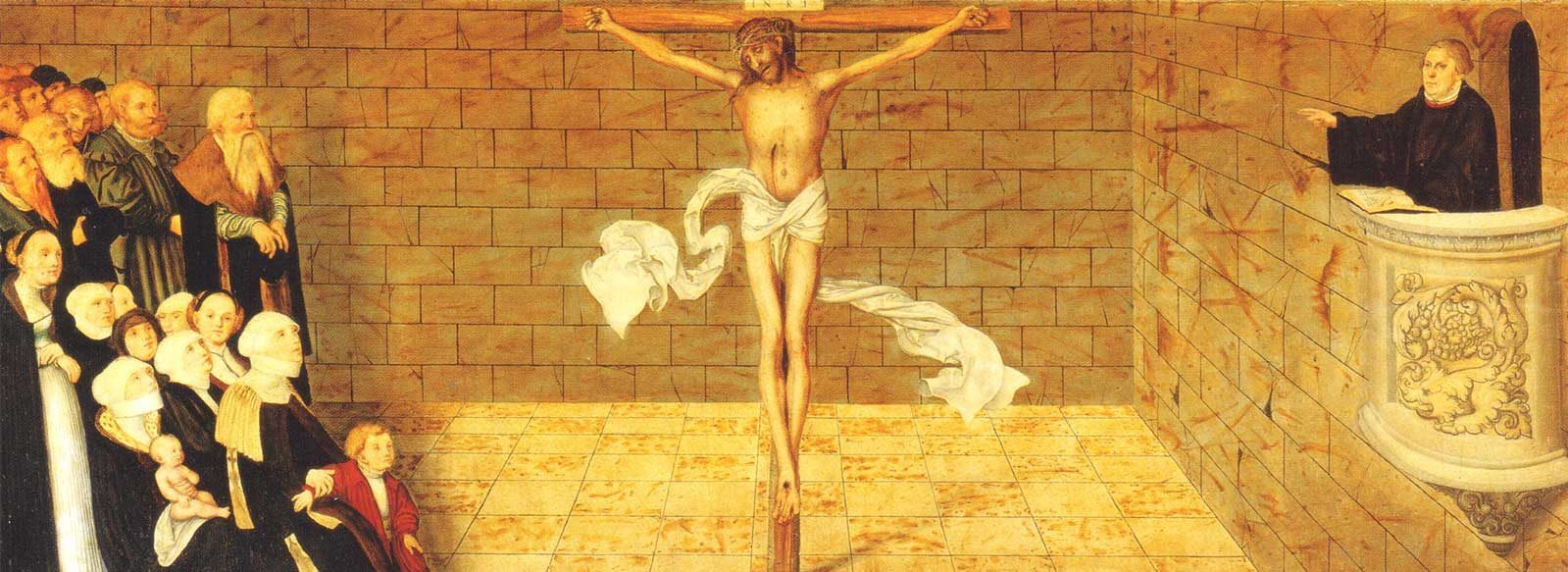
The glory of the bloodied God
His fruitfulness in shame
Stooped lower than all men have trod
In torment in the flame

The writhing worm, disjointed dry
Rejected from His birth
Thrust groaning into Satan's sky
Accursed by heaven and earth

Hell's blackest cloak enfolds with death
From Pinnacle to pit
To choke the Source of Living Breath
Extinguish all that's lit

The Mighty Man at war cries out
It echoes ‘gainst the sky
Resounding as a futile shout
Within a victory cry

Creation torn from Head to toe
His body out of joint
The Rock that splits is split in two
Creation to anoint

Our Jonah hurled as recompense
Into abysmal depths
The beast that swallows Innocence
Is swallowed by His death

Divine appeasing blood poured out
Divinely pleasing scent
While man appraises with his snout
Declares it death's descent

Crowned in curse, enthroned on wood
My God nailed to the tree
The reigning blood, that cleansing flood
Is opened up for me.

.

5

Here I spoke about trinitarian marriages.

Here I spoke about trinitarian families.

Here I spoke about trinitarian churches.

In each case it's about differently aged/gendered/gifted people taking on different roles but united in love and common purpose.  I spoke about the heresies of arianism, modalism and tritheism which they could fall into.

But I'm just aware that these models of how community should be are Law.   Law is holy, righteous and good.  Law describes the good life - the life of the truly Righteous One.  But there is no power in Law to be able to effect what it describes.

We can day-dream about a truly Athanasian marriage/family/congregation.  And we can bemoan a Sabellian one.  But we can't create one by simply defining the Original, despising the counterfeits and trying harder.

Which is why, when the Scriptures describe trinitarian community, they centre on something that I, in my descriptions, left out.  Christ's cross.

So think of Romans 14 and 15 - a wonderful passage on crunchy community - unity with distinctions upheld by gracious deference to the other.  But at the heart of it all is the cross (14:9,15; 15:3,7) which creates such community.

Or think of 1 Corinthians 11-14.  We begin with Father-Son unity (11:3); we continue with the expression of this unity in marriage (11:3ff); we see it play out in the body (12 and 14) and in chapter 13 we see it all held together by love.  That's fantastic.  But what have I missed out?  The Lord's Supper - 11:20-34.  This community is not created by trying hard to imitate the trinity.  It is created by the cross as experienced in the sacrament.  The one loaf creates the one body - a body in which the weak and despised are received and knit together.

So anyway, just a thought that brings me back to some earlier posts:

Triune glory is cruciform glory

Participating in God means participating in the cross

Correct me if I'm wrong, but I don't think you can become a triune community by trying to be a triune community.  Or can you?

Right now I'm thinking that a community created by and centred on the cross will be a triune community.  Descriptions of true triune community can diagnose problems in our communities.   But they can't solve them.

Which means maybe I should just put away my fancy diagrams and preach Christ and Him crucified.

What do you think?

.

3

Just playing around with some thoughts.  Comments welcomed...

Jesus Christ crushed the head of Satan (Gen 3:15); drove out the devil (John 12:31) and disarmed the rulers and authorities, putting them to open shame and triumphing over them (Col 2:15).

How?

Through dying on a cross.

He didn't come down from the cross to bust out some ultimate fighting moves on the devil.  It's not that, as He died, the Spirit went to work on Satan behind the scenes with baseball bats and chains.  The cross wasn't Christ's non-violent resistance stunt distracting us while the elect angels went ballistic on the forces of evil.

No, it's all there on Golgotha.  The all-time decisive cosmic face-off did not involve hordes of spiritual forces doing battle in the heavenlies.  It involved a lonely Man on a lonely hill.  The taunts of the devil rang out from the lips of His enemies: "If you are the Son of God, come down now from the cross."  The diabolical onslaught did not come through waves of black magic but through the simple appeal to use power and save self.

The greatest ever spiritual battle involved the simple choice of whether this Man would obey His Father or serve Himself.  The height and width and breadth of the battlefield was that single cross.  The one Victor was that Champion strung up on a tree.  Right there this defenceless Man was crushing, driving out, disarming and triumphing over evil once and for all.

What does that tell you about evil?

Well if it was something like an equal and opposite force, then you might expect a heavenly punch-up.  But it's not.  It's not a created thing but a perversion.  It's a parasite, distorting everything good and pulling it down into oblivion.  (See these recent Mike Reeves talks on evil for more).

And so the Author of Life enters into this matrix of death.  Christ absorbs this evil at its worst and transforms it.  He does this, not by taking it seriously as a legitimate opponent but by entering it in simple obedience to His Father's will.  As this Man trusts God - even in the jaws of death - He reverses the cycle of self-assertion and self-vindication.  This cycle is the very opposite of God's own life and therefore the quintessence of evil.  So the Source of good goes to the heart of evil and, by turning the other cheek, overturns the whole thing.

Therefore we get the ultimate Genesis 50:20 moment.  Even what Satan intends for evil, God intends for good.

So, again, evil is not granted an existence alongside God and His creation-redemption agenda.  It is a perversion which is then taken up into the purposes of God and made to serve Him.

Well then.  We stand, clothed in Christ and His victory.  And the evil one, thrashing around in his death-throes, fires some flaming arrows our way - some mixture of temptations and condemnations.  And both James and Peter tell us "resist the devil" (1 Pet 5:9; James 4:7) and James adds the promise "and he will flee from you."

That's always seemed to me an extraordinary promise.  Doesn't it sound a little far fetched to believe that I can send Satan scurrying into the night?  Yet that's exactly what "fleeing" means - running scared.  And how are we going to make Satan flee from us?  Simply by resisting him.  That just means 'standing against' him.  He wants you to indulge a craving, you simply stand against it.  Nothing more, nothing less, just resist.  He wants you to wallow in past sins, you simply stand against it.  And the devil runs for his life!  He has met a Christian - a little Christ - one clothed in the Champion and employing those same tactics.

If that sounds incredible to us, maybe we don't properly understand Satan or his defeat.  Recently the devil's been coming at me with some recurring thoughts about myself.  Ordinarily I'd get embroiled in an endless round of indulging the thoughts and then condemning myself for them.  Either way he wins.  I can't explain exactly why but of late I've just known a real freedom to laugh at the temptations - whether I've caught myself entertaining them or not.  Whatever.  I'm not called to engage Satan mano e mano.  That battle's been won.  And I don't get to nip his temptations in the bud - that's not an option.  My job's pretty simple.  Just stand in Christ and refuse to take his temptations seriously.

And maybe to fart at him.

.

4

Last time I finished on this thought:

It’s a wonderful thing to participate in the divine nature (2 Peter 1:4).  But the very essence of it is taking up your cross and following Christ (Mark 8:34)

It got me thinking about the three 'Abba, Father's of the New Testament.

In Galatians 4:6 we read about the Spirit of adoption praying the Son's prayer within us - 'Abba, Father.'  If anything is 'participating in the divine nature' it's this.  God adopts you into God's communion with God.  And He carries on His life of union and communion in us.  Deeper than your heartbeat is the Spirit's cry within you.  This is your true spiritual pulse.  Abba, Father.  Abba, Father. Abba, Father.

In Romans 8:15 we join in with the Spirit.  Adding our Amen, we make Christ's prayer our own and call out to the Father in that same childlike dependence. Again, this is wonderful participation in God.

But what about the original 'Abba, Father'?  Mark 14:36 - Christ is sweating blood at the prospect of drinking the cup.  With loud cries and tears He prays with reverent submission, "Your will be done." (cf Heb 5:7).  The original 'Abba, Father' is prayed in the midst of Christ's total self-offering.

It's this prayer that is placed within us.  Not just any intimacy with the Father but the intimacy of the obedient Son, obedient even to death on a cross.

Now our co-crucifixion with Christ is something that's graciously happened entirely outside ourselves.  It's first happened for us and then been applied to us.  But now that we've granted this we must confess it's something that happens in us too.  The gift of participating in God is the gift of participating in the obedient self-offering of the Son.  It's not a warm bath and a cup of herbal tea.  It's much more earthy and glorious than that.  In fact it's much more profoundly joyful than that.  We will experience fellowship in the communion of the trinity as we experience fellowship in Christ's sufferings.

10 I want to know Christ and the power of his resurrection and the fellowship of sharing in his sufferings, becoming like him in his death, 11 and so, somehow, to attain to the resurrection from the dead.  (Phil 3:10-11)

5

A meandering waffle...

Recently I've written about the glory of the triune God.  This glory is His other-centred love.  When He acts for this glory it's not because He or His glory are self-centred.  No He is other-centred and His glory is His grace.  But just because this is so, when God acts for the sake of His glorious grace He is simply determining to be Giver.

From eternity the nature of the triune God has been deferral and other-centred praise.  When faced by creatures, even creatures who would ignore and spurn such love, this God determines to love with an almighty 'nevertheless'.

It's like the mother who is faced by a naughty and manipulative child.  She could cave in to the tantrum or she could withdraw and ignore the child altogether.  But she condescends in love, not because the child is good (he's not) and not because she's weak (she's not).  She acts in accordance with her gracious motherliness, to love the child in spite of himself and in this way to lift him from his misbehaviour.

Put it another way, it's like the man who is struck on the right cheek by an aggressor.  By nature his instincts are fight or flight - strike back or withdraw.  But instead he stands his ground and offers his left cheek also.  He opens himself out in grace and continues the offer of relationship.  This is God-like glory.

Put it another way, it's like Christ crucified.  He might have remained in heaven or merely sent us to hell.  Instead He acted for the sake of His glory.  He absorbed our blow and rather than retaliate He offered reconciling love.

The cross was the triune love laid bare.  And this is not simply because the Persons demonstrated how much they love and act for one another.  More than this, they demonstrated how the glory of grace encounters what is outside this love.  In costly sacrifice the triune glory suffers what is outside in order to draw it in.

How do we respond to this glorious God?  Well we rejoice in the grace of Jesus shown to us - the terrible children and violent aggressors.  And we pass on the divine glory we have received.  Out of the fulness we have received we empty ourselves (which is precisely the dynamic we have seen from the triune God in the cross of Christ).  Out of the strengthening of Christ's Spirit we will adopt cross-shaped love towards others and in every circumstance imaginable practise costly cheek-turning.  (More on cheek turning here, here and here).

In this sense "What would Jesus do?" is exactly the question to ask in every ethical situation.  Just make sure your answer is always: To receive the grace of the Father and lay down our lives for the unworthy.  Once you're looking for opportunities, it's surprising how often you'll be able to apply the wisdom of the cross in daily, practical cheek-turning.  And this is what it means to 'glorify God.'  The glory of the cross lived out is the glory of the triune God applied.  Because the triune glory is the cruciform glory.

It's a wonderful thing to participate in the divine nature (2 Peter 1:4).  But the very essence of it is taking up your cross and following Christ (Mark 8:34)


A sermon on Hebrews 10:1-18. 

Audio here (recording failed at church, re-recorded at home).

Out, damned spot! out, I say!

Lady Macbeth’s line is one of Shakespeare’s most famous.  In the first act of Macbeth she helps her husband to murder the King and by the end of the play she is in mental torment and eventually takes her own life.  In her final scene she is before a doctor and cannot cleanse her conscience.

Out, damned spot! out, I say!... who would have thought the old man to have had so much blood in him?   ...What, will these hands ne’er be clean?...Here’s the smell of the blood still; all the perfumes of Arabia will not sweeten this little hand. Oh, oh, oh!

The Doctor says

What a sigh is there! The heart is sorely charg’d. ...This disease is beyond my practice.

Shame and guilt is a disease.  And it’s a disease beyond the practice of 17th century doctors.  It’s beyond the practice of 21st century doctors.  Cleansing away our guilt and shame is beyond every power on earth.

But it’s what this chapter is all about.  Verse 2 – it’s about being cleansed and no longer feeling guilty for our sins.  Verse 3 – it’s about not being reminded of our sins.

Instead, v10, it’s about being made holy.  Verse 11, having our sins taken away.  Verse 14, being made perfect.  Verse 17 – our sins and lawless acts remembered no more.  Verse 18 – it’s about forgiveness.

It’s a passage all about sin and shame, cleansing and forgiveness.  It’s a passage about whether your sins are forever remembered, or forever forgotten.  It’s a passage about guilt.

Do you feel guilty?

Now as I ask that question there’s a big danger.  Those who should feel guilty, often don’t.  And those who shouldn’t, often do.  So as I ask “Do you feel guilty?” there will be some of you who, personality wise, are virtually impervious to feeling ashamed.  You’re just you and that’s the way you are.  And there’ll be some of you who, personality wise, almost never feel anything but guilty.  Our feelings about guilt are so unreliable, which is why this chapter is so helpful.  Because this chapter will help us to make sure our feelings are anchored in reality, and not just in personality.

But so long as we’re aware that there’s such a thing as false guilt – and that’s wrong – what about true guilt.  Do you feel guilty?

You know there’s a trick that preachers can pull to make you feel guilty.  We can confess to one or two old sins of ours that are embarrassing and we can say – “I’m sure you’ve got embarrassing sins that you keep locked in your basement too, don’t you?”  And I could make you dwell on your past right now and there’d be a handful of things in your past for which you felt shame.  And it would usually be that misuse of alcohol, or that misuse of sex, or that misuse of a friend, or those words you said that you would immediately bring to mind.  Now if you are wracked with guilt about individual sins listen in to this chapter because there is liberation from all guilt here in Hebrews 10.  But the guilt we’re mainly talking about in this chapter is not about that one sin or those half-dozen sins, or even those wilderness years of back-sliding.  The guilt we’re talking about is the all-pervading knowledge that in myself, I am utterly unfit for God’s presence.

Because the context for these 18 verses is all about “drawing near” to God.  It’s not the guilt that comes when you’re doing the washing up and you remember that awful thing you did.  It’s the dread feeling of being summoned, not just into the Headmaster’s office, not just summoned before a magistrate, but summoned before the Judge of all the world.  This is about the problem of guilt not just because it causes unpleasant feelings, but it’s about the problem of guilt because we are summoned into God’s presence.

Look at the last six words of verse 1 – we’re talking about “those who draw near to worship”.  And in v22 he tells us the outcome of all this teaching: “[therefore]... let us draw near to God.”

Drawing near to God is mentioned 7 times in Hebrews.  And at the same time, chapter 10 verse 31:

It is a dreadful thing to fall into the hands of the living God.

Draw near – but if you happen to be His enemy it’s a dreadful thing.  Draw near – but, chapter 12 verse 29 – our God is a consuming fire.  Draw near – but He is a furnace of goodness, beauty, truth and holiness.  But draw near.

The kind of guilt we’re talking about in Hebrews 10 is the knowledge that when we’re summoned into the presence of the consuming Fire, we’re not up to it.

...continue reading "True Guilt, True Cleansing – Hebrews 10:1-18"
R.C. Sproul has recently written against the notion that "God died on the cross".  Big topic.  Not gonna jump in with both feet here.  But allow me to dip a toe...

Just listen to this key paragraph in his argument:

If the being of God ceased for one second, the universe would disappear. It would pass out of existence, because nothing can exist apart from the sustaining power of God. If God dies, everything dies with Him. Obviously, then, God could not have perished on the cross.

Now ask yourself - what definition of death is being used by Sproul?  The bible's?  Or Bertrand Russell's?

In the bible, death is a realm over to which the Father has handed humanity in its rebellion.  It's a realm the Son enters so as to be firstborn from among it.

Where on earth do we get the idea that death = non-existence?

Who knows where Great Aunty Beatrice is, but she's not nowhere. Sproul knows that the dead do not cease to be.  But, like so many other theologians who discuss this issue, they use the theist's definition of God and the atheist's defintion of death.

.

.

It was 3 days from the arrival at Sinai to law-giving. (19:11)

1 day later the blood of the covenant was sprinkled on the people (24:4)

6 days after that Moses enters the glory cloud on top of the mountain (24:16)

For 40 days Moses receives the instructions for the tabernacle (24:18)

So when Moses descends the mountain we have a kind of a Pentecost - a 50th day.

But it's a reverse-Pentecost.  The nations are repulsed (32:25).  3000 people die (v28), cf Acts 2:41).  And all because they didn't wait for the LORD (v1, cf Acts 1:4).

The people have always wanted (and needed) someone to go before them.  The Unseen LORD had promised His Divine Angel to fight at their head (23:20ff).  He was the One who had commissioned Moses (3:2) and brought them out of slavery (14:19) on eagles wings (19:4) to serve God Most High (3:12).  Moses and the elders have seen Him and eaten with Him (24:9ff).  Yet He obviously wasn't moving according to the people's timetable.  So in impatience they settle for counterfeits - a religious substitute for Christ.  (Notice the same sin again in 1 Samuel 8:20 - this time the Israelites seek a political substitute for Christ - one 'to go before them').

In contrast to the free and liberal giving for the tabernacle, Aaron demands offerings for his false gods (v2).  False religion is always compelled, true worship of the LORD is always free.

The plunder from the Egyptians (3:22; 12:36), instead of being pressed into the LORD's service, is made into a golden calf.  But this is idolatry no matter how much the LORD's name is invoked (v5).

Why a calf?  Well Psalm 106:19-20 clarifies that this is the calf of an ox.  Now when you put Ezekiel 1:10 and 10:14 together you see that cherubs are like oxen.  And we all know who the guardian cherub is (Ezekiel 28:14ff).  Here is worship of Satan!  Within a month of being sprinkled by the blood of the covenant and solemnly vowing to uphold it, while Moses is on the brooding fiery mountain with God Most High, here they are worshipping the devil.  Notice how "the LORD" is invoked in their Satan worship - a salutary lesson that not everyone who says "Lord, Lord" is truly serving Him!

These people deserve the burning wrath of the LORD out of the heavens (v10; cf Gen 19:24).  But just as Moses had interceded for wicked Pharaoh (e.g. 8:8) now he intercedes for wicked Israel.  The LORD had called Israel "your people" (v7), Moses responds to the LORD - they are "your people" (v11) and implores the LORD to turn (shub) from wrath and have compassion (naham) (v12).  The LORD does indeed have compassion / is sorry but this is not the end of the matter.

Moses descends the mountain with the same burning anger as the LORD Himself (v19).

Through the priests he executes a judgement on the people - this is the Levites' ordination!  (v29) They have always been blood-thirsty men: "their swords are weapons of violence." (Gen 49:5)  When you came to a Levite to confess your sin, you were coming to a violent man with a sword.  As he plunged that sword into the animal substitute you would be left in no doubt that this blood-shed is precisely what you deserved.

But even after this blood-shed, Moses realises there's still a work of atonement to be performed:

I will go up to the LORD; perhaps I can make atonement for your sin. (v30)

Here's what he offers to the Father:

Blot me out of the book you have written. (v32)

He doesn't offer the blood of goats or bulls, he doesn't offer the blood of the guilty.  He offers his own blood - the blood of the innocent, the blood of a Levite, the blood of the people's ruler.

Would Moses himself be the promised Lamb to be provided on the mountain to make atonement?  Genesis 22:1-14 has been promising just this atonement for centuries - the Lamb on the mountain as a burnt offering.  And Abraham is certainly on Moses' mind (v13).  Would Moses be the One to make atonement?

No.  God Most High declines Moses' offer.  Instead He reminds him of His Angel - the true leader of the people (v34).  The true Warrior and Commander at their head was indeed going before them.  They must continue to wait for Him and to trust in Him.

One day He would descend from the heavenlies, the Divine Angel and Saviour, an Intercessor for the people, a Priest in the order of Melchizedek, the Ruler of rulers and a true Innocent.  He would be handed over to death by Levites, killed by piercings and blotted out of the Father's book.  And right there in bloody sacrifice the true God is on show for the whole world.  Not a golden calf.  More of a bronze serpent.  But this is the real God.  Every other god is a counterfeit.

.

.

He began to be sorrowful and troubled. Then he said to them, "My soul is overwhelmed with sorrow to the point of death."  (Matt 26:37-38)

He fell with His face to the ground and prayed.  (Matt 26:39)

"Abba, Father," He said, "everything is possible for you. Take this cup from me. Yet not what I will, but what you will."  (Mark 14:36)

Being in anguish, he prayed more earnestly, and his sweat was like drops of blood falling to the ground. (Luke 22:44)

During the days of Jesus' life on earth, he offered up prayers and petitions with loud cries and tears to the one who could save him from death  (Heb 5:7)

"My Father, if it is not possible for this cup to be taken away unless I drink it, may your will be done." (Matt 26:42)

Perhaps no bible story has had more impact on me than the account of Jesus praying in Gethsemane.  It haunted my teenage years especially.  It said to me: 'This is what honouring God looks like.  This is the epitome of religious devotion - overwhelmed to complete prostration, loud cries and tears, commitment to the point of death.'

And I attempted to emulate this.  Not in practical, daily 'thy will be done' service - no, no!  Instead I would attempt to re-enact Gethsemane.  I'd sneak out of the house at night and find somewhere really scary - a forest in dead of night was best.  And I would literally fall on my face and ask God to take my life, to make me His servant, to do whatever He wished with me.  (Of course I imagined that His wishes would be awful, dark and painful).

Nonetheless Gethsemane had taught me that this was the way and so I'd try (unsuccessfully) to work myself up into some kind of hyper-serious state of emotional sincerity.  I was massively aware that I was falling short of offering the required... what?  devotion?  gravity?  sacrifice?  Whatever was needed, I was painfully aware of lacking it.  But I made my dramatic teenage offering and waited for the results.  But no angel came to comfort me.  No spiritul blessing was poured out.  No command from heaven.  Just an overwhelming sense that heaven was silent and my devotion was clearly not sufficient to rouse Him.

And, over time, my response to this was 'God doesn't want me, I don't want Him.'  I wandered from Him for years.  But it was Gethsemane that brought me back.  Because all of a sudden I saw what should have been most clear all along.  I'm not at the centre of Gethsemane! I'm sleeping with Peter, James and John.  I'm the weak, flesh-driven, good-for-nothing follower who cannot stay awake even for one hour.  But Christ!  He prays to the Father.  He intercedes for His worthless, pathetic friends.  He offers to drink their cup.

And suddenly it all fell into place.  Christianity was not about me burying my face in the dirt for Him.  He buried His face in the dirt for me.  It's not about me stooping low enough to be worthy.  It's about Him stooping lower still because I'm not.  I don't offer my life to a silent heaven.  The Man of heaven offers His life for a silent, sleeping, sinful me.

Gethsemane is good news.  There's so much more to be said.  But perhaps it's said best by my favourite preacher on this my favourite passage:  Click here for Mike Reeves on Gethsemane.  Well worth the free registration!  Check it out.

Or here's a men's breakfast talk I did on the subject.

.

Twitter widget by Rimon Habib - BuddyPress Expert Developer