Skip to content

3

Sometimes I'm asked whether we should spend time entering into non-Christian "world-views" to expose their internal inconsistencies.

Sure - if you do it like this.  But then, if you do it like this (and do listen to the song) you're not seeking to convict them of a logical contradiction but an existential one.  The former contradiction can be solved by conversion to Aristotle.  For the latter, only Jesus saves.

.

Sometimes I'm asked whether we should spend time entering into non-Christian "world-views" to expose their internal inconsistencies.

Sure - if you do it like this.  But then, if you do it like this (and do listen to the song) you're not seeking to convict them of a logical contradiction but an existential one.  The former contradiction can be solved by conversion to Aristotle.  For the latter, only Jesus saves.

.

Skeptic Daniel Florien asks his mainly atheist/agnostic readers what it would take for them to believe.

The first 3 of 87 responses (and counting) are:

"Evidence and an explanation that makes sense"

"Evidence"

"Show himself and fix the world"

One commenter I've interacted with before said this:

"For me, god would have to demonstrate how the universe makes more sense with him in it. Something no religious person has ever been able to do."

I like how that first sentence begins.  I groan when I get to the words "in it".

Anyway, the whole thing is really fascinating reading.

.

On this recent Australian panel show Richard Dawkins was served up a number of Christian politicians on a plate.  And he quite rightly ate them for breakfast.  Of course, given their distinct lack of back-bone, they wouldn't have been hard to chew.  But you do have to wonder why the key match-ups weren't scientist versus scientist, or atheist versus Christian - but atheist scientist versus... MP.  Huh?

Anyway both Pete and I found this particular quotation from Dawkins interesting.

I think that the existence of a supreme being - a supernatural supreme being - is a scientific issue. Either there is a God or there isn't. Either there are gods or there are no gods. That is a... supremely important scientific question. If the universe was created by an intelligence, then we are looking at an entirely different kind of scientific theory from if the universe came into existence by natural means. If God or gods had something to do with the creation of life, then we're looking at a totally different kind of biology...

So I think you can't just say religion and science have nothing to do with each other. Science can get on and you let people have their own religious - of course you let people believe whatever they like. But you cannot say that science and religion are completely separate because religion makes scientific claims. It certainly makes scientific claims about miracles, as I mentioned before, and you cannot reconcile an authentic approach to science with a belief in miracles or, I suspect, with a belief in supernatural creation. At least the very least you should say is that this is a scientific question.

Here was an oasis of clarity in a desert of dualism.  While other panelists were falling over themselves trying to affirm both evolution and "the one who provided the amino acids in the first place”, Richard refused to compartmentalise either religion or science.  Good.

But if Dawkins is right here - and I think he is - then there are two major mistakes you must avoid.

1) You must avoid tacking on some kind of super-intending god to the science of naturalism. Whatever god of the gaps is left by a scientific method designed to exclude the supernatural is not the God and Father of our Lord Jesus Christ.  Christian assumptions mean a very different way of doing science .  There may be great overlap at points but the foundations are very different.  Don't pretend that Christian assumptions matter in the theology class but not the science class.  They matter as profoundly in theology as they do in science (and everything else!).

2) You must avoid judging creationists by the very same scientific method used for naturalistic enquiry.  If indeed science 'with God' would be conducted differently than science on atheistic assumptions then to test the effectiveness of YEC science you'd want to avoid just assuming they were wrong, wouldn't you?  I mean that wouldn't be very fair - not very scientific.  Well then, you're going to have to walk a mile in their shoes rather than simply test them by a scientific method that excludes divine words from the outset.  Instead, if you want to do science ‘with God’ – you’d better allow Him to BE God. ie You’d better allow Him to speak, for that to be your authority and then to move out into the world on the basis of His word. That would be good science wouldn’t it?  If God is God – that would be the only kind of science you could do.

So I think Dawkin's words need to be heeded here - first by Christians who want to conduct and affirm science on common foundations to naturalists.  But second by Dawkins himself.  If he really believed that science ‘with God’ was entirely different then he wouldn’t be judging YEC science by naturalistic science. But he does this all the time!

.

.

33

I lost some of the best years of my life last month to an atheist blog.

With that in mind, I was amused at the recent furore over comment moderation at richarddawkins.net.  People are surprised at the vitriol spewed forth under pseudonymous cover in the under-belly of RichardDawkins.net?  A forum devoted to one of the most vituperative fundamentalisms going?  Does this shock anyone?

A couple of weeks ago I commented on a well respected and well-read atheist blog and was sworn at and wished dead in the most imaginatively vicious ways.  Compared to the abuses I and other Christians suffered there, the "rat's rectum" comparisons that flew between fellow-atheists at Dawkins' site sound like Pollyanna.

Anyway, I thought I'd try to redeem my experience by reflecting on some things I learnt, and some things I should have:

One reflection on my experience was written during the interchanges: Evangelists and Apologists Note: The six things that have already happened.

Here are some other reflections:

  1. Reason flows from the heart.  These guys raised a banner loud and proud for reason, logic, the scientific method, etc,.   But there was nothing particularly reasoned or scientific about their manner of argument.  They were well read intelligent people (PhD students etc) but much of their commenting consisted in caps locked swear words.  "Logic" was their slogan not their method.
  2. They constantly appealed to a logical high-ground without any thought as to whether they were allowed one - being materialists and all!
  3. Pointing out this inconsistency didn't seem to get me anywhere (though you never know how non-commenting readers are responding).
  4. Everyone deals in circularities:
    1. I believe the bible is the word of God because in it God speaks
    2. You believe the scientific method is the arbiter of what's true because it's proved itself effective when judged by science.
  5. Everyone has ultimate authorities which, by the nature of the case, cannot be authenticated by outside sources - ie the scientific method cannot be tested by the scientific method.  One guy admitted that this self-validation hasn't happened yet but that one day science would definitely be able to prove the scientific method by the scientific method.  There's faith for you.  Which leads to...
  6. Everyone is faith based.  We all proceed from assumptions which we take to be true and then move forwards on the basis of them.
  7. I kept getting asked for 'evidence'.  My responses were in three broad categories, first I'd point to Christ risen from the dead, second I'd simply quote Scriptures.  But probably the most effective thing was to say "everything!  Everything reveals the LORD Jesus to you."
  8. Therefore evangelism is the invitation to the unbeliever to step inside the world in which Jesus is LORD and look again.  Basically it's saying: "Let me tell you a story about a triune God, the world He made and the Son who redeems it.  Now look again at the world through the Lens of Jesus.  Now do you see why self-giving love is the greatest thing?  Now do you see why trust and beauty, evil and forgiveness, truth and goodness are real beyond any scientific analysis?  In other words, now you can take seriously the most basic aspects of your human existence and not run against the grain of reality all the time."
  9. In this sense theology is a science.  It begins with self-authenticating premises and moves out in faith to investigate .  This investigation is shaped by the Object of knowedge.  Since the Object of knowledge is the Speaking God, the method is to hear His Word.  The premises of our enquiry after knowledge (e.g. Jesus is LORD, the bible is true etc) are not falsifiable in the way the materialists demand they be.  But then the scientific premises (e.g. that true knowledge is verified by the scientific method etc) aren't falsifiable either.  Premises are the light by which we see.  It's their success in seeing that recommends them.
  10. The failure of "science alone" to see the world was very evident to me.  It didn't seem particularly evident to them.  That Beethoven's 9th was a series of compression waves was certain for them.  That it was "beautiful" was a verdict they couldn't make with anything like the same certainty.
  11. The atheists who commented were very clearly captured by the vision of "the onward march of science", demolishing ignorance and dispelling superstition.  There was clearly a love for scientific progress that had won their hearts.  Nothing less than a greater love could ever displace this.  All their calls for "evidence, evidence" were simply calls for reality to fit into their paradigm - to serve their greatest love.  They need a new paradigm, or better - a new love.
  12. The call for "evidence, evidence" in the sense that they mean is a desire to be confirmed in their self-imposed naturalistic prison.  What counts as 'evidence' for them is only that which can be assessed according to their naturalistic paradigm.  This is simply a refusal from the outset to hear a Voice from above.  Again it is a matter of hard-heartedness, however seriously they wish to be taken intellectually.
  13. My lowest point came in the heat of battle when I fired off a comment justifying my intellectual credibility.  I'm ashamed of what I took pride in at that moment.  I should have borne shame and taken pride in the foolishness of the gospel, allowing Christ to vindicate me.  The cause of the gospel was hindered rather than helped by the assertion of my academic credentials (which weren't that great anyway!).  This is especially so given what I've been arguing above.
  14. Having said all this, I think it was a worth-while exercise.  Many of the commenters were American 'de-converted' evangelicals and knew a lot of bible.  The hurt from previous scars was palpable and I hope that a charitable Christian voice might at least temper some of the "all Christians are bigots" tirades that otherwise spiral on in these forums.
  15. On the other hand, some of the commenters were angry Brits and others who seemed to know very little of Christian things.  All they've heard has been from other atheists.
  16. And of course there were many more who I'm sure just 'listened'.  My time at Speaker's Corner taught me that even as you engage the Muslim apologist in front of you, you're aiming at the wide-eyed apprentices hanging off his coat-tails.  Who knows how the Lord will use these words?
  17. Turning the other cheek hurts but it's powerful.  I trust that (#13 and other lapses notwithstanding) perhaps the most useful aspect of the interchange was the attempt to model Christ in the way I commented.
  18. The absolute hatred for Christians is frighteningly palpable.  The hatred that's there in the comments sections will rise more and more into the public realm, that seems pretty certain to me.  But if we're surprised and outraged let's get a grip - no soldier should act all offended and hurt when the enemy actually shoots bullets at them!
  19. Just as Stephen Fry speaks of descending into the "stinking, sliding, scuttling" floor of the internet, engaging in this kind of way can be the faintest taste of what the LORD Jesus did in descending to a world that hates Him.  (It can be a total waste of time too, but I think there is a time and a place for it).  I spent a few hours in an internet forum.  His whole life He lived and loved and spoke and served among a hatred that literally tore Him apart.  He's the One we proclaim.  His attitude is the attitude we take.  And as we join Him (in big ways and small) in cross-bearing love, we get to know His enduring grace that much more.
  20. There is a time for shaking dust off your feet.  Some need to spend a little longer in the battle.  But probably people like me (who have to be right!) should quit sooner.  :)

.

.

  1. Through Christ, the Triune God has already revealed Himself unmistakably in every aspect of creation so that humanity is without excuse.
  2. Against Christ, humanity has taken knowledge into its own hands and so barred the door against all claims from above.
  3. In view of Christ, God has handed humanity over to its chosen futility, locking the door from His side too.
  4. In Christ, God has entered this prison and manifested His eternal glory in time and space, even in human flesh.
  5. As Christ, humanity now has a perfect mind with which to comprehend God (and everything else) - one that is not only human but also in God.
  6. Out of Christ, His Spirit has been poured to incorporate us into the Man who knows.

This is what has already happened.

Here's what happens when we forget 1:

We think:

  • That the universe is basically mute (when actually it's preaching day and night)
  • That humanity is not really deaf - they're listening hard but the sermon's too quiet
  • That we, therefore, have to piece together proofs to amplify the sermon
  • That 'evidence' for God exists only in some limited aspects of the creation (e.g. fine-tuning)
  • That there are certain obvious pointers to "God" but 'Jesus' and 'Trinity' are actually pretty obscure
  • Therefore, that evangelism is a three-part process from creation to God to Jesus. (It's the very opposite!)

Here's what happens when we forget 2:

We think:

  • That humanity (or at least some humans) are actually truth seekers
  • That the mind is somehow less fallen than the rest of the person (rather than the centre of our enmity)
  • That fallen humanity is genuinely questing after the capital-T Truth when it makes its enquiries
  • That the way forward is to agree to their own systems of truth verification
  • Therefore that we need to find 'evidence' to submit to their systems

Here's what happens when we forget 3:

We think:

  • Perhaps if our faulty grasping after knowledge was the problem, our true grasping after knowledge will be the solution. (Instead we should realize that the grasping was the problem!)
  • If we now reason properly we can reverse the fall. (But no, God has confirmed our decision and locked the door from His side).
  • Maybe God is pleased by our efforts to ascend to knowledge (rather than thwarting them - catching the 'wise' in their craftiness)
  • Maybe God will aid our efforts to shepherd an unbeliever up the mountain. (In His grace, He might aid the unbeliever but not our efforts)

Here's what happens when we forget 4:

We think:

  • Christ is the cherry on the epistemological cake.
  • We can (or even should) should reason from creation to Christ (rather than Christ to creation).
  • Christ is one relevation among many (rather than the one Lens through which all must be seen)

Here's what happens when we forget 5:

We think:

  • There remains within Adamic humanity a capacity for knowing God (rather than realizing that this capacity lies in Christ alone).
  • That the quality of our conversion, or ongoing knowledge of God, finally depends on our own reasoned response to God.  (At base it relies on Christ's reasoned response to God).
  • Christians are rational individuals raised to a higher intellectual plain (rather than fools united to a Person who is Wisdom).
  • Once we have come to Christ we can know God autonomously.  (No, only in Him by the Spirit can we go on knowing God)

Here's what happens when we forget 6:

We think:

  • Maybe we need Jesus to bring us to God, but it's up to us to get to Jesus.  (No, it's the sovereign work of the Spirit through the gospel word).
  • Maybe there are ways and means to get to Jesus apart from the Spirit-empowered word.  (No.  While the whole universe screams 'Jesus is Lord', the Spirit unblinds our eyes to these things only as He shows us Christ in the word).

.........................................

So then, these six events have already happened.  Acting like they haven't happened or they need bolstering by our own efforts betrays the gospel that we proclaim.

The only thing that needs to happen now and the only thing that can happen now to remedy our situation is for the Spirit to sweep the unbeliever up into the Son's knowledge of the Father.

And, lest we divorce the Spirit from the word, the only means by which the Spirit does that is the gospel word.

So get proclaiming.

.

What do you see when you look up?

This?

http://www.youtube.com/watch?v=b0lxbzgwW7I

or this:

ht Mark Meynell

A theological revolution occured early last century when Karl Barth turned from his liberal protestant heritage to jump with both feet into "the strange new world of the bible" (the title of an early book of his).

Have you jumped in, or only dipped your toe?  It's a very hard thing to do.

It's so hard, you might just need Mike Reeves, Michael Ward and CS Lewis as guides.  So if you haven't listened to this brilliant podcast - do so forthwith.

.

Stephen Baldwin has been ridiculed for his comments on Celebrity Big Brother regarding evolution.  He said:

If we're descended from apes, how come there are still apes?

Ok, a misunderstanding of the theory.  But is the theory more or less silly than the misunderstanding?

Here's Richard Dawkins answering the very objection Baldwin makes.  See if you can watch it with a straight face:

[youtube="http://www.youtube.com/watch?v=wh0F4FBLJRE"]

What we have here is a Professor of Zoology faced with a line up of four apes and an accountant from Swindon.  And he refuses to identify the odd one out.  The whole story he invests his life in says that none are superior to any other - all are equally well adapted to their environment.  It's just 4 monkeys and Pam sitting in a tree -  M-U  T-A-T  I-N-G.

To say that Dawkins has put Baldwin right is like saying:

Ohhh.  Sorry for thinking your theory was nuts.  I thought you believed in alchemy.  Now I realize you have a magical goose to lay your golden egg.

.

.

Since the earthquake - more than one million have died worldwide.  150 000 per day.  Every day without fail a Haiti-sized disaster strikes.  This is not to play down the horror of this crisis.  It's to awaken us to a daily horror that we accept all too readily.  56 million people - that's almost the whole UK population - return to dust every year.  And I will be one of those statistics.  Sometime this century.  I live on a fault line every bit as treacherous as the Enriquillo-Plantain Garden fault zone.  No house could ever be structurally sound enough.  This world will be the death of me.

'Not one stone will be left on another, every one will be thrown down' said Jesus about the house of God (Mark 13:2).  This was just the start of a top-down judgement.  First the flesh and blood House of God was torn apart on the cross.  Then the brick and mortar house of God in AD70.  One day it will be God's house - the whole cosmos - that comes crashing down.  The stars from the heavens, the sky torn in two, the moon turned to blood.  It's scheduled for demolition.

Can you imagine how the disciples would have viewed the temple after Mark 13?  For the next 40 years they would visit the temple (e.g. Acts 2:46) but they would never again be taken in by its 'massive stones' and 'magnificent buildings (Mark 13:1).  They knew it was about to be shaken to its foundations.

We know that earth and heaven will be shaken (Heb 12:27-28).  And in the meantime, we see portents.  Earthquakes (Mark 13:8).  This is the world that we know.  Tsunamis destroy, volcanoes erupt, plagues devour, cyclones flatten, wildfires rage and the very earth upon which we stand quakes.

But here's a surprise.  Jesus doesn't call these 'death-throes'.  He calls them 'birth-pains'. (Mark 13:8)  Because the demolition to which we are heading is, in fact, a palingenesia - the renewal of all things. (Matt 19:28)  This top-down judgement is for the sake of a top-down resurrection.

We're heading towards 'the end' - the goal of all things (Mark 13:7,13); summer (v27); the cloud of His presence (v26); gathering (v27) and the power and glory of the Son of Man (v26).  We're heading for a new heavens and new earth - a kingdom that 'cannot be shaken' (Heb 12:28).

May this earthquake awaken true compassion in us - (here are some places to give money).  May the Body of Christ speak boldly of the Redeemer from all evil (Genesis 48:16) and demonstrate His suffering love in the midst.

But may we also reconsider our own precarious position.  This ground is not solid.  Not right now anyway.  It will be shaken and it groans under the weight of sin and curse.  It will rise up to strike me down and swallow me whole.  Yet so often I marvel at the 'massive stones' and' magnificent buildings' of 'this present evil age.'  I cosy up in the demolition site.

May we wake again to the reality of a whole world under judgement.  May seeing these deaths re-ignite our hatred of death.  Every day the tragedy of Haiti is repeated the world over.  But mostly we try to ignore that the last enemy is swallowing everything we love!  Let us wake up and snort with indignation at the grave the way Jesus did (John 11:33-38).

And then, through the lens of His resurrection may we look to the most audacious hope - a new Haiti, secure, prosperous, radiant, gathered under the wings of the Son of Man, every tear wiped away by the Father Himself.

The non-Christian can hope for nothing greater than 'safer' buildings on the same old fault line.  And as they labour admirably for this, many will ask why God does not seem to be cooperating with their desire to pretty up the demolition site.  They plan to build some lovely houses on this sand and they imagine God to be standing in the way of their saving purposes.  Of course it's the other way around.  And of course it's we who have a small view of redemption.

The Lord has a salvation so audacious He can call earthquakes 'birth-pains'.  (As can Paul - Rom 8:22).  Certainly they are birth-pains.  But they are birth-pains.  Jesus has a redemption so all-embracing that it will include even these evils.  It won't simply side-step Haiti, or make the best of a bad situation, it will (somehow!) lift Haiti through this calamity and birth something more glorious out of the pain.

We know this because Jesus began the cosmic shake-down with His own destruction.  And He was perfected through this suffering (Heb 2:10).  His death (Matt 27:54) and His resurrection (Matt 28:2) were attended by earthquakes - they were the original earth-shattering events.  And through this death and resurrection was birthed a new creation reality beyond death and decay (1 Cor 15:54-57).  Where the Head has gone, we will follow, and the whole creation with us.  And as Christ bears and exalts the wounds of His own suffering into eternity, somehow the evils of this last week will also be caught up into resurrection glory.

I don't pretend to know how and I don't pretend that this answers our grief or our questions.  It's the answer of faith and not sight.  But, unlike the answer according to 'sight', this answer takes us deeper into the tragedy - we all face this fate (Luke 13:4-5!).  And it points us much higher to its redemption.

.

.

My sermon on Mark 13 from last year

.

.
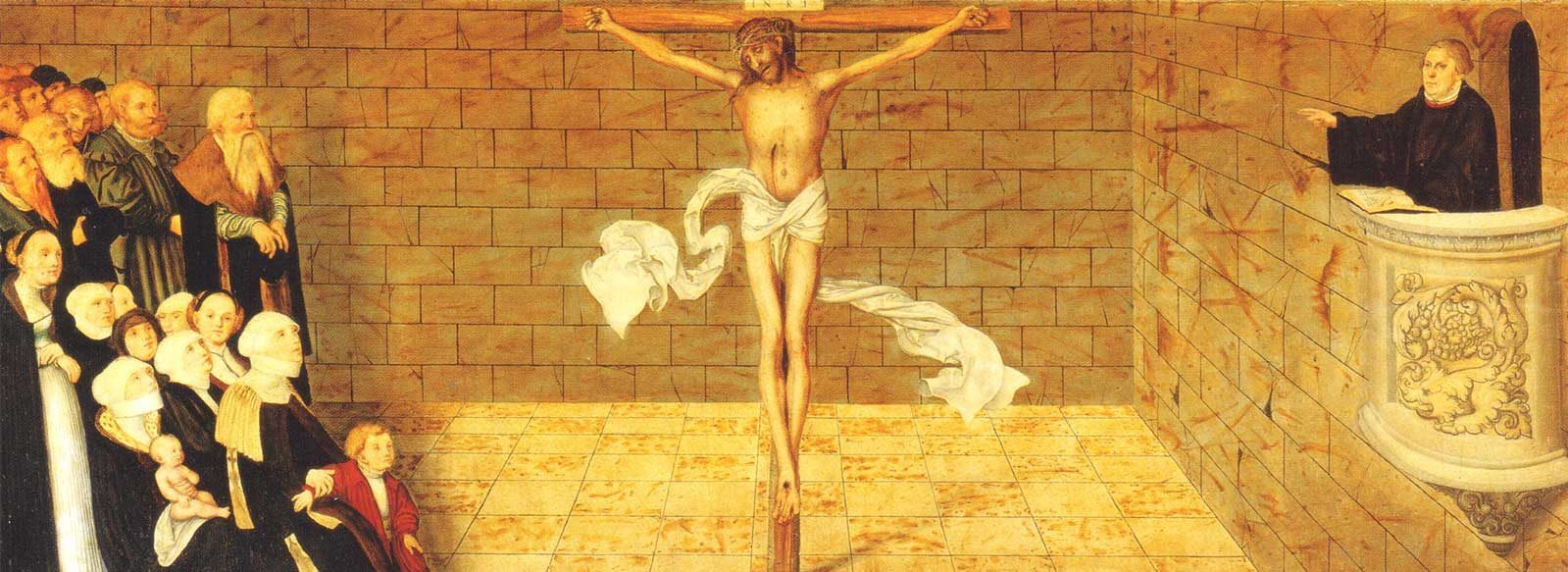
I was recently discussing original sin with some people who disagreed with it.  It seemed to them something like the doctrine that 'God hates babies'.  Fumbling around for what to say, I eventually settled on this.

If you buy into the 'born neutral' position, you're living in a world in which performance is everything.  God's waiting with a clip-board to assess how you develop the 'blank slate' He's given you.

If you go for the 'born in sin' position, you're living in a world in which God's grace to sinners is everything.  It's all about His forgiveness, not our good behaviour.

The bible says "God has bound all people over to disobedience so that He may have mercy on them all." (Romans 11:32) Original sin is actually all about the mercy of God.

Initially original sin may sound like the harsh option.  Actually the 'born neutral' position is the really harsh doctrine.  Especially once you become aware of your own sin.

If I've failed to convince you that 'original sin' is what the bible teaches, can I at least convince you that ongoing sin is true in your own life?  And if you realize that ongoing sin is a problem for you, let me ask you which world you'd rather live in - the world of performance or the world of grace?

.

Twitter widget by Rimon Habib - BuddyPress Expert Developer